The Quick Answer
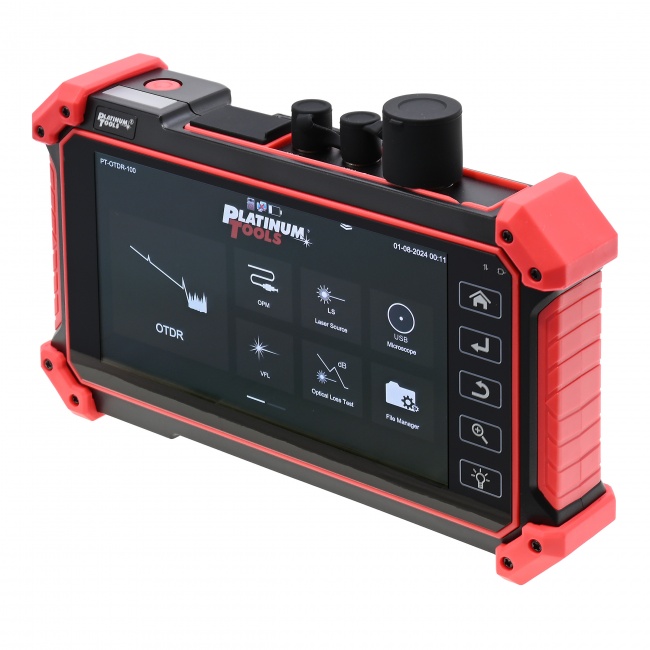
For most techs buying a first mini OTDR, our pick is the Platinum Tools PT-OTDR-100. It tests single-mode fiber at 1310 and 1550 nm over a test range of 3 m to 105 km, and the same handheld has a power meter, a VFL, a light source and a copper TDR for twisted pair. Use it with a 150 m single-mode launch cable: the Universal Launch Cable Ring or the Universal Launch Cable Box. We also sell the QBL Fiber Ranger, a mini OTDR. We do not have QBL's spec sheet for it yet, so we do not recommend it for a job that depends on a specific number.
Comparison
| Product | What it is | Who it is for | What decides it | Price |
|---|---|---|---|---|
| Platinum Tools PT-OTDR-100 | Mini OTDR and copper tester | Techs testing single-mode drops, risers and campus links, especially if they also work on copper | 1310 and 1550 nm; dynamic range 28 dB at 1550 nm and 26 dB at 1310 nm; test range 3 m to 105 km; built-in power meter, VFL and light source; copper TDR for twisted pair | $931.78 |
| QBL Fiber Ranger | Mini OTDR | Techs whose jobs do not depend on a published spec | We do not have QBL's spec sheet yet | $579.99 |
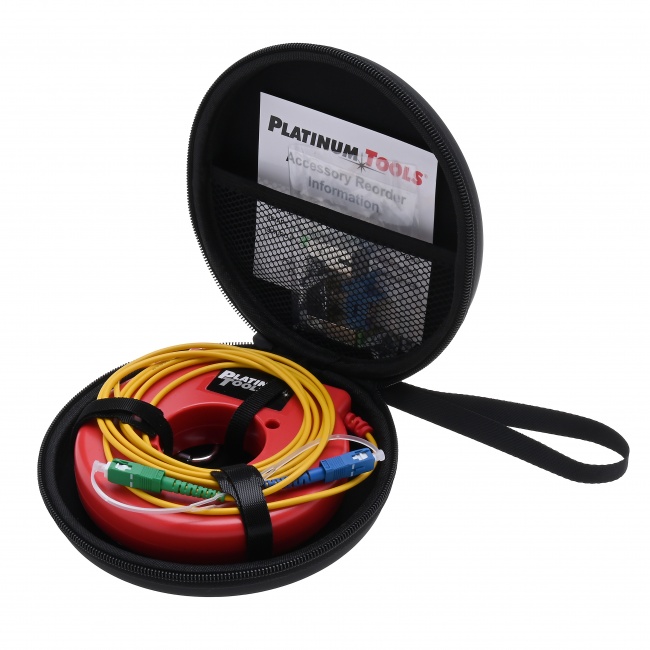
| Universal Launch Cable Ring | Single-mode launch cable on a ring | Anyone running OTDR tests on single-mode fiber | 9/125 single-mode, SC/APC to SC/UPC, 150 m (also offered in 500 m and 1,000 m) | $226.67 |
| Universal Launch Cable Box | Single-mode launch cable in a box | Anyone running OTDR tests on single-mode fiber | Same fiber and connectors as the ring, in a box (also offered in 500 m and 1,000 m) | $425.00 |
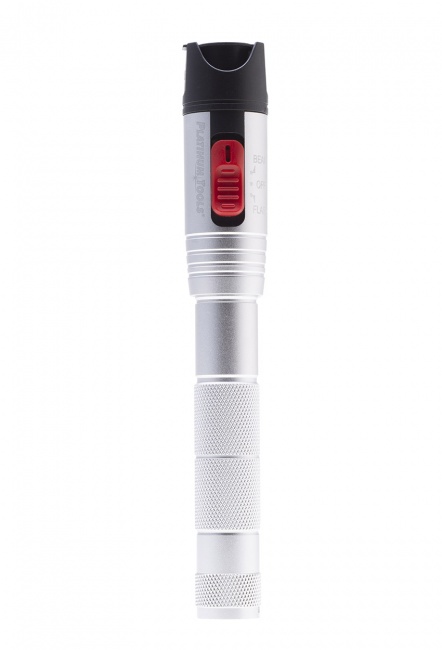
| Platinum Tools Visual Fault Locator | Visual fault locator | Checking patch cords and the first stretch of a link | 10 mW visible laser | $140.94 |
The Picks
Platinum Tools PT-OTDR-100: Our Pick for Most Techs
Best for. Techs who test single-mode FTTH drops, building risers and campus links, and contractors who work on both fiber and copper and would rather carry one handheld than two.
What it does well. The PT-OTDR-100 tests at 1310 and 1550 nm, the two standard single-mode wavelengths. Platinum Tools lists a dynamic range of 28 dB at 1550 nm and 26 dB at 1310 nm, and a test range of 3 m to 105 km. It runs an automatic test that draws an event map, and it saves results as SOR or PDF files, so you can hand a customer a report or open the trace in other software. Besides the OTDR, it has a built-in optical power meter, a visual fault locator and a laser light source. For copper, it has a TDR for twisted pair cable. The screen is a 5.5 in OLED touchscreen at 1280 x 720, the unit weighs about 1 lb (0.45 kg), and it carries a 1-year manufacturer warranty.
What it does not do. Its listed wavelengths are single-mode only, so it is not the tool for 850 nm or 1300 nm multimode testing. Its copper TDR is for twisted pair, not coax. It is not a cable certifier for fiber or copper. And an OTDR trace does not replace a light source and power meter loss test when a job spec calls for one; see OTDR vs power meter for when each is used.
QBL Fiber Ranger
We sell the QBL Fiber Ranger, a mini OTDR. We do not have a spec sheet for it from QBL yet, so we are not quoting its wavelengths, range or settings here. If your job depends on a specific number, such as dynamic range for a long drop, buy the PT-OTDR-100, whose specs are published.
You Also Need a Launch Cable
An OTDR cannot clearly read the first stretch of fiber after its own port. That blind stretch is called the dead zone. A launch cable goes between the OTDR and the link, so the first connector of the link appears after the dead zone, where the OTDR can evaluate it. The same kind of cable used at the far end, called a receive cable, does the same job for the last connector. Our guide to OTDR launch and receive cables covers both.
We sell two Platinum Tools launch cables with the same fiber and connectors: 9/125 single-mode fiber, SC/APC on one end and SC/UPC on the other, 150 m long, with 500 m and 1,000 m versions on the same product pages. The Universal Launch Cable Ring is wound on a ring. The Universal Launch Cable Box is housed in a box. Pick the one that suits how you carry your gear. Before you order either, check both connector types against your OTDR port and the connectors on the links you test.
The VFL That Pairs with It
A visual fault locator shines visible red light into a fiber. Breaks, tight bends and bad connectors glow where the light escapes. That makes a VFL a quick check on patch cords and the first part of a link, which is the part an OTDR sees least clearly. The PT-OTDR-100 has a VFL built in. If you want a separate one in the truck, the Platinum Tools Visual Fault Locator is a 10 mW visible laser.
VFL or OTDR First?
If you mostly work on patch cords, short building runs and splice closures, a VFL is the cheaper first tool. It shows you where light is escaping, as long as you can see the fiber or its jacket. It cannot tell you the distance to a fault you cannot see, and it does not measure loss.
If you test drops and runs you cannot see end to end, or a customer wants a trace, you need an OTDR. It shows the distance to each connector, splice and break, and how much loss each one adds. If you expect to need both, a mini OTDR with a VFL built in covers both jobs in one handheld.
Mini OTDRs We Do Not Sell
You will also see handheld OTDRs from EXFO (the MaxTester line), VIAVI (SmartOTDR) and Fluke Networks (OptiFiber Pro). We do not sell them. If you are comparing, ask each one the questions in the next section.
How to Choose a Mini OTDR
- Fiber type. Single-mode testing uses 1310 and 1550 nm. Multimode uses 850 and 1300 nm. Check that the OTDR lists the wavelengths for the fiber you test.
- Distance. Check that the test range covers your longest link, and look at dynamic range, which tells you how much loss the OTDR can measure through before the trace fades.
- What else it does. A built-in power meter, VFL and light source mean fewer tools in the bag. A copper TDR matters only if you also test twisted pair.
- Reports. If customers want results, check the file formats. SOR is the common trace format; PDF is what most customers can open.
- The rest of the setup. Budget for a launch cable and for cleaning supplies. A dirty connector on the launch cable shows up on every trace you shoot. Our guide to cleaning fiber connectors covers the routine.
FAQ
What is a mini OTDR?
A mini OTDR is a handheld optical time domain reflectometer. It sends pulses of light down a fiber and reads what comes back to show where connectors, splices, bends and breaks are, and how much loss each one adds. It is smaller and simpler than a full-size OTDR and is made for shorter runs such as FTTH drops and building fiber.
Do I need a mini OTDR or a full OTDR?
For drops, risers and campus links, a mini OTDR is usually enough. Long-haul and high-count backbone work is where a full-size OTDR is usually needed. Our mini OTDR vs full OTDR comparison goes through the differences.
Do I need a launch cable with an OTDR?
Yes, if you want to evaluate the first connector on the link. An OTDR cannot clearly read the first stretch of fiber after its port. A launch cable moves that first connector past the dead zone so it shows up on the trace. A receive cable at the far end does the same for the last connector.
What pulse width should I use for FTTH?
Pulse width trades detail for reach, and the right setting depends on the length of the link and what you are looking for. Our OTDR pulse width guide walks through the choice.
Can the PT-OTDR-100 test multimode fiber?
Its listed wavelengths are 1310 and 1550 nm, which are single-mode wavelengths. Multimode testing uses 850 and 1300 nm, which are not among its listed wavelengths.
Does the PT-OTDR-100 test coax?
No. Its copper TDR is for twisted pair cable, not coax.
Shop OTDRs and Launch Cables
See every OTDR, launch cable and fiber tester we carry in test equipment.
Related reading: