
Fiber Fusion Splicers: Single-Fiber and Ribbon Models
Field-portable fusion splicers for FTTH, backbone, and ribbon splicing applications.
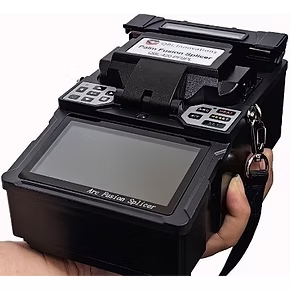
ShopFiberOptic carries fusion splicers for single-fiber and ribbon cable splicing. The Palm Fusion Splicer ($2,349.99) is a compact core-alignment splicer for FTTH drop and enterprise fiber work. The Ribbon Fusion Splicer ($8,799.99) handles mass-fusion ribbon cable for backbone and MDU applications where splicing speed per fiber matters. Replacement batteries and SC/APC hot fusion connectors are also stocked.

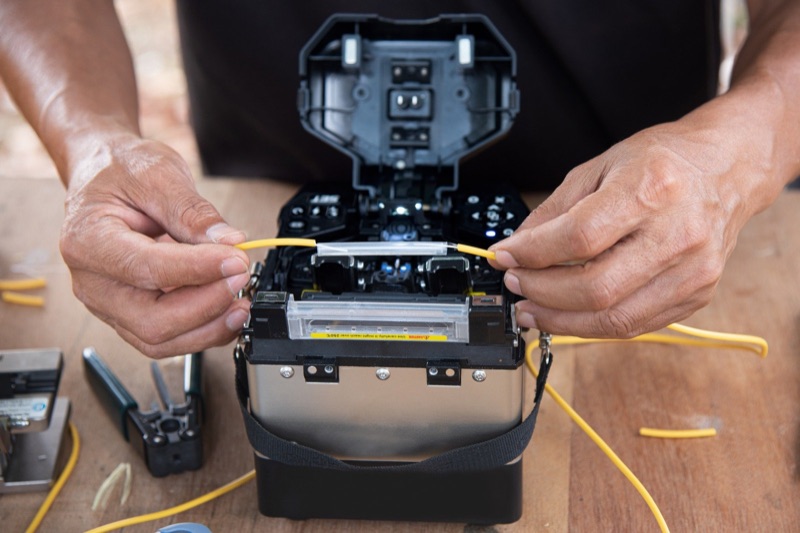

Fusion splicing melts two fiber ends together with an electric arc to create a permanent, low-loss joint. It produces splice losses in the 0.02 to 0.1 dB range on single-mode fiber, well below the 0.3 dB typical for mechanical connectors.
The Palm Fusion Splicer ($2,349.99) is a single-fiber arc fusion splicer in a compact enclosure. It is suited for FTTH drop fiber, campus riser fiber, and field repair work where portability matters. It handles both single-mode and multimode fiber. ShopFiberOptic's blog covers selecting the best fusion splicer for FTTH deployment with a detailed comparison.
The Ribbon Fusion Splicer ($8,799.99) is a mass-fusion splicer for ribbon cable. Ribbon cable packs 4, 6, 8, or 12 fibers into a flat array, and a ribbon splicer joins all fibers simultaneously in a single arc. This dramatically reduces splice time per fiber on backbone and MDU projects where hundreds or thousands of fibers need to be spliced.
Replacement Fusion Splicer Battery ($139.99) is stocked for both models. Splicer battery health declines over charge cycles, and a spare battery keeps a crew working through a full day of splicing without returning to a vehicle or AC power.
For SC/APC mechanical hot-fusion connectors, the SC/APC Hot Fusion Connector 10-Pack ($16.99) is also available.
Frequently Asked Questions
What fusion splicer do I need for FTTH deployment?
For FTTH drop fiber (G.657A1 or G.657A2 bend-insensitive single-mode), a compact single-fiber splicer like the Palm Fusion Splicer ($2,349.99) is the standard choice. It handles the small-diameter drop cable commonly used in FTTH last-mile drops and is portable enough for aerial and pedestal work.
What is the difference between core alignment and cladding alignment fusion splicers?
A core-alignment splicer uses cameras to image and align the fiber cores directly before splicing, which produces the lowest and most consistent splice loss. A cladding-alignment splicer assumes the core is centered in the cladding and aligns by cladding position only, which is faster but can produce higher loss on fibers with core-cladding concentricity variation. Core alignment is preferred for single-mode fiber in carrier and FTTH applications.
When would I use a ribbon fusion splicer instead of a single-fiber splicer?
When you are splicing ribbon cable, typically in aerial closures, building entry points, or central office environments where 12-fiber or higher-count ribbon cable is used. Mass-fusion splicing all fibers simultaneously reduces per-fiber splicing time significantly compared to individual single-fiber splicing, which matters on projects with large fiber counts.
What is the expected splice loss for a fusion splicer?
A properly calibrated fusion splicer on clean, well-cleaved single-mode fiber typically produces splice losses in the range of 0.02 to 0.1 dB per splice. Higher loss indicates a cleave quality issue, dirty fiber, or a splicer arc calibration problem. The splicer's built-in loss estimation displays the estimated loss after each splice before you close the splice protection sleeve.