The Quick Answer
What Each Class Is
Mini OTDR
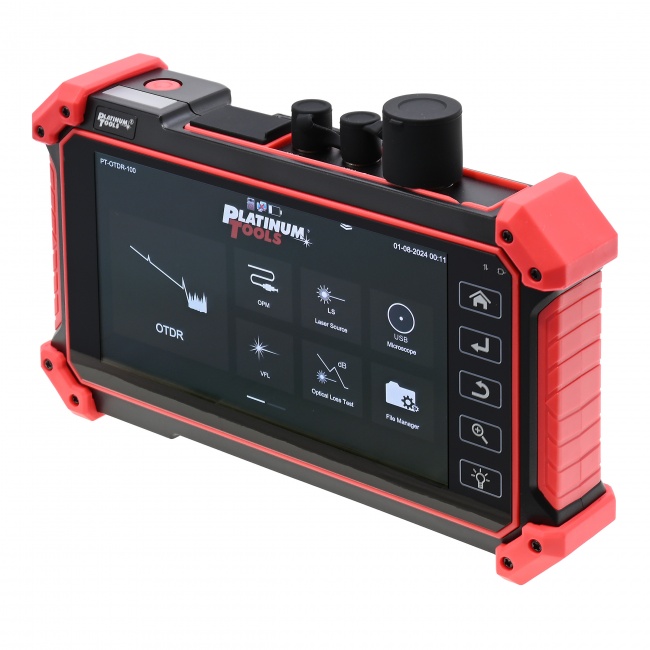
A mini OTDR is a compact handheld instrument optimized for FTTH and short-to-medium fiber testing. The form factor fits in a tool belt or laptop bag. Battery runtime is 6-12 hours depending on use. Touchscreens have replaced traditional buttons on most modern mini OTDRs, with single-tap auto-test modes for routine field work.
Typical mini OTDR specs: 25-30 dB dynamic range, two single-mode wavelengths (1310 and 1550nm), pulse widths 5 ns to 1-3 microseconds, event dead zone around 1 meter, attenuation dead zone around 5 meters at minimum pulse width. These specs are tuned for FTTH drops, splitter cabinets, and access network fiber up to roughly 30-40 km.
Full-Featured OTDR
A full-featured OTDR is a benchtop or rugged-handheld instrument with the dynamic range, wavelength coverage, and accuracy needed for long-haul fiber and carrier-grade acceptance work. Form factors range from rugged handhelds slightly larger than a mini OTDR to full benchtop instruments. Many models accept modular optics so the same chassis can support different fiber types and wavelength sets.
Typical full-featured OTDR specs: 40-50 dB dynamic range, three or four wavelengths (1310, 1490, 1550, 1625nm with optional 1383nm for water-peak testing), pulse widths 3 ns to 20 microseconds, event dead zone under 1 meter, attenuation dead zone under 4 meters. Built-in trace analysis software is standard, with comparison-to-baseline, multi-trace overlay, and detailed acceptance reporting.
Side by Side: Mini OTDR vs Full-Featured OTDR
| Feature | Mini OTDR | Full-Featured OTDR |
|---|---|---|
| Dynamic Range | 25-32 dB | 40-50 dB |
| Wavelengths | 1310, 1550nm | 1310, 1490, 1550, 1625nm |
| Max Reach (single-mode) | ~40 km | ~200+ km |
| Pulse Width Range | 5 ns - 1-3 us | 3 ns - 20 us |
| Event Dead Zone | ~1 m | ~0.5-1 m |
| Battery Runtime | 6-12 hours | 4-8 hours (or AC) |
| Weight | 1-2 kg | 3-7 kg |
| Form Factor | Tool belt portable | Bag or cart portable |
| Live Fiber Testing (1625nm) | Rare | Standard |
| Multimode Capability | Optional | Optional |
| Trace Analysis Software | Basic on-device | Advanced PC-based |
| Price Range | $1,500-$4,000 | $8,000-$25,000 |
When a Mini OTDR Is Enough
FTTH Installer Crews
Daily FTTH drops, splitter verification, ONT activation troubleshooting -- all within the mini OTDR's reach and resolution. The form factor is critical here: an installer climbing a pole or working in an MDU closet wants a tool belt instrument, not a 5 kg benchtop. The Fiber Ranger OTDR targets exactly this use case.
Access Network Maintenance
Cabinet to cabinet, central office to remote terminal -- typically under 30 km. The mini OTDR's 25-30 dB dynamic range is more than sufficient. Two wavelengths (1310 and 1550nm) cover all standard fault detection needs. Most municipal and regional access work fits the mini OTDR profile.
FTTH Splitter Work
Splitter cabinets have closely spaced events that need short pulse widths and small dead zones to resolve. Mini OTDRs are designed around these short-pulse use cases. A 5 ns pulse with 1 m event dead zone resolves splitter outputs cleanly.
Field Troubleshooting
Customer trouble tickets, intermittent service, reported slow speeds. The mini OTDR characterizes the drop fiber in 5 minutes and identifies whether the fault is in the fiber or in the customer-side equipment. Most field troubleshooting fits the mini class.
When You Need a Full-Featured OTDR
Long-Haul Fiber
Backbone fiber over 50 km, regional interconnect, DWDM systems. The 40-50 dB dynamic range is required to reach the far end with usable trace quality. Pulse widths up to 20 microseconds are necessary for the longest runs. Mini OTDR dynamic range simply runs out around 40 km.
In-Service Testing
Testing fibers that are carrying live traffic requires 1625nm to avoid disrupting transmission. Full-featured OTDRs include 1625nm; most mini OTDRs do not. For carrier maintenance work where service must continue during testing, this is non-negotiable.
Carrier Acceptance Documentation
Tier 1 carrier and large ISP acceptance specs typically require multi-wavelength bidirectional traces with detailed event analysis. Full-featured OTDRs have the wavelength coverage and analysis software built for this workflow. Mini OTDRs can do bidirectional 1310/1550 testing but lack the comprehensive analysis features.
Multi-Generation PON Networks
Networks running mixed GPON, XGS-PON, and 25G-PON benefit from 1490nm and 1577nm OTDR wavelengths to characterize each PON downstream wavelength specifically. Full-featured OTDRs offer these wavelengths; mini OTDRs typically only cover 1310/1550. For comparison of PON power meters across these wavelengths, see GPON vs XGS-PON power meters.
Specialty Fiber Characterization
Polarization-maintaining fiber, dispersion-compensating fiber, water-peak testing at 1383nm, multimode at 850/1300nm with encircled flux calibration -- all require specialized features typically found only on full-featured OTDRs.
Decision Framework
Match the OTDR class to the work, not the other way around. Buying more instrument than you need wastes capital. Buying less makes some jobs impossible.
- FTTH installer or access tech, fibers under 30 km: Mini OTDR. Save the budget.
- Backbone fiber up to 50 km, no live-fiber testing required: High-end mini OTDR (30+ dB dynamic range) or low-end full-featured OTDR.
- Long-haul fiber, multi-wavelength, or in-service testing: Full-featured OTDR.
- Carrier acceptance contractor: Full-featured OTDR. The work requires it.
- Mixed work, mostly FTTH with occasional long-haul: Buy mini OTDRs for crews, rent full-featured for the occasional long-haul project.
- Multi-generation PON network operator: Full-featured OTDR with 1490/1577nm wavelengths.
- Test lab or training facility: Full-featured OTDR. Wavelength flexibility matters.
Specs That Actually Matter When Comparing
OTDR datasheets list dozens of specifications. Most are marketing noise. A few actually determine which OTDR is right for your work.
Dynamic Range
The single most important spec. Dynamic range determines how far the OTDR can see into the fiber before signal disappears into noise. Higher dynamic range equals longer reach. Each additional 5 dB of dynamic range translates to roughly 25-30 km more reach on standard single-mode at 1550nm. A 25 dB OTDR reaches ~30 km; a 35 dB OTDR reaches ~80 km; a 45 dB OTDR reaches ~150 km.
Event and Attenuation Dead Zone
The minimum spacing for resolving closely spaced events. Important for FTTH, splitter cabinets, and patch panels. Mini OTDRs typically have ~1 m event dead zone and ~5 m attenuation dead zone at the shortest pulse width. Full-featured OTDRs achieve ~0.5-1 m event dead zone and ~3-4 m attenuation dead zone. For most FTTH work the difference is irrelevant; the mini-class spec is good enough.
Wavelength Coverage
1310 and 1550nm are the standard single-mode pair and cover most testing needs. 1625nm enables in-service testing on live fiber. 1490nm and 1577nm enable PON-specific characterization. For non-PON work, 1310/1550 alone is fine.
Pulse Width Range
Shortest pulse determines best resolution. Longest pulse determines maximum reach. A 5 ns to 1 microsecond range covers FTTH and access; 5 ns to 20 microseconds covers everything including long-haul.
Battery Life
Field techs need 8+ hours of runtime to get through a day without charging. Bench techs do not care because the OTDR is plugged in.
What to Ignore
Sampling resolution numbers below 5 cm are marketing. The OTDR cannot actually resolve events finer than its event dead zone regardless of sample resolution. "Storage capacity" numbers are irrelevant -- modern OTDRs have plenty of storage for typical job loads.
Buying Considerations Beyond the Spec Sheet
Calibration and Service
OTDRs require periodic calibration -- typically annually -- to maintain measurement accuracy. Factor calibration costs ($300-800 per year) into total cost of ownership. Service availability matters: an OTDR from an obscure manufacturer may be unrepairable when it fails.
Software Ecosystem
Modern OTDR workflows depend on PC-based trace analysis software. Mini OTDRs typically include basic free software; full-featured OTDRs come with advanced software that supports comparison reports, baseline overlays, and acceptance documentation templates. Test the software before buying -- if it is awful, daily use becomes painful.
Connector Adapter Modules
Most OTDRs use replaceable connector adapters so the same instrument can test SC, LC, FC, and ST fibers. Verify the adapters you need are available. APC vs UPC adapters are also separate; FTTH crews need APC, data center crews need UPC.
Training and Certification
If your crew lacks OTDR experience, factor in training. Most OTDR manufacturers offer 1-2 day classes covering setup, trace interpretation, and acceptance testing workflows. Certification is increasingly required by carriers and contractors.
OTDR Is Not Enough on Its Own
Whatever OTDR class you pick, the OTDR alone does not test a fiber link completely. A complete fiber test kit includes:
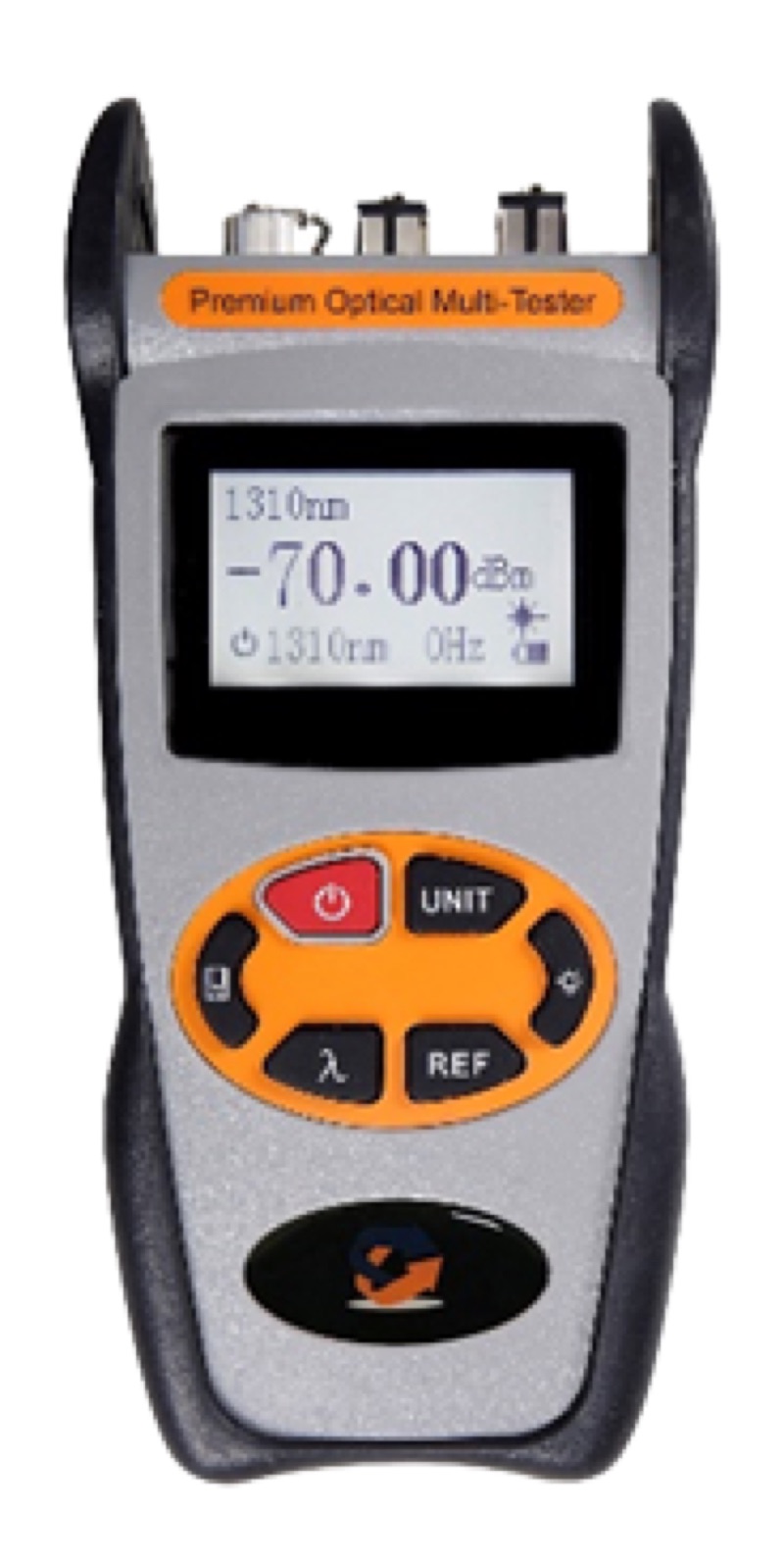
- Optical power meter for absolute end-to-end loss certification. OTDR vs power meter covers why both are needed.
- Visual fault locator for fast continuity verification before launching an OTDR shot. The VFL Pen 5km covers most FTTH ranges.
- Fiber inspection scope for connector endface verification. The WiFi Fiber Microscope with appropriate inspection tips.
- Cleaners for connector preparation. The CLEP-25 for 2.5mm ferrules and CLEP-125 for 1.25mm ferrules.
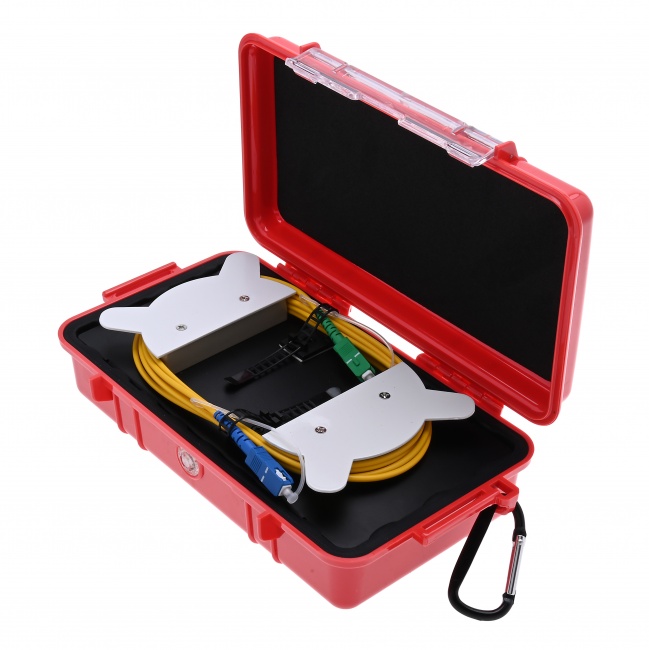
- Launch and receive cables sized to the OTDR's pulse width range. See OTDR launch and receive cables for sizing.
- Optical fiber identifier to verify a fiber is dark before connecting an OTDR. The Optical Fiber Identifier handles this.
Recommended OTDR Selection
For most FTTH and access network work, the Fiber Ranger OTDR is the right mini-class instrument. Pair with a complete OTDR test kit including launch fiber, inspection scope, cleaners, VFL, and power meter. Total kit investment is typically $2,500-$4,500 for a fully equipped FTTH crew member.
For complete OTDR test workflow guidance, see how to launch an OTDR test step by step, OTDR trace interpretation, and OTDR pulse width explained.
Used and Refurbished Market Considerations
Full-featured OTDRs hold value reasonably well, especially the major brands. The used market can stretch a tight budget, but it has pitfalls.
Calibration Status
An OTDR more than 12 months past its last calibration certificate is suspect. Field testers requiring traceable measurements (per TIA-568, ISO/IEC 11801, or RUS contract requirements) need a current calibration cert. Factor in a $300-600 calibration cycle when buying used.
Battery Health
Battery packs in 5+ year old OTDRs are usually at 50% or less of original capacity. Replacement batteries from the OEM run $300-500. Aftermarket batteries are cheaper but may shorten field session length. Plan to replace batteries on any OTDR older than 3 years.
Software and Firmware
Older OTDRs may not be supported by current PC analysis software. Verify that .sor files from the unit can be opened and analyzed by your reporting software before committing. Some manufacturers stop supporting older models entirely after 8-10 years.
Connector Wear
The OTDR's bulkhead connector is a wear item. After 10,000+ mating cycles the bulkhead ferrule needs replacement. A used OTDR with high mating cycles may need a new bulkhead before producing reliable measurements. OEM bulkhead replacements are typically $150-300.
OTDR Selection Workflow
The right OTDR depends on your work mix. Use this decision sequence to narrow choices.
- Step 1: What is the longest link you regularly test? Under 5 km, a mini will work. 5-40 km, mid-tier or full-featured. Over 40 km, full-featured.
- Step 2: Do you test live fiber? If yes, you need 1625nm capability and an in-service filter. Most mini OTDRs do not have either. Full-featured required.
- Step 3: Do you bidirectional-test for splice loss documentation? If yes, you need software that handles bidirectional analysis. Mini OTDRs vary; full-featured units have it standard.
- Step 4: How often do you test? Daily use justifies a higher purchase price because daily users care more about speed and reliability. Occasional use can tolerate slower instruments.
- Step 5: What is your customer mix? If your customers run RUS-funded fiber projects or telco contract work, the documentation requirements often dictate full-featured OTDR with current calibration.
Browse OTDRs and Test Equipment
Mini OTDRs, full-featured OTDRs, optical power meters, and complete fiber test kits for FTTH, access network, and metro fiber work.