The Core Distinction
Both instruments measure optical loss in fiber, but they do it differently and the results have different uses.
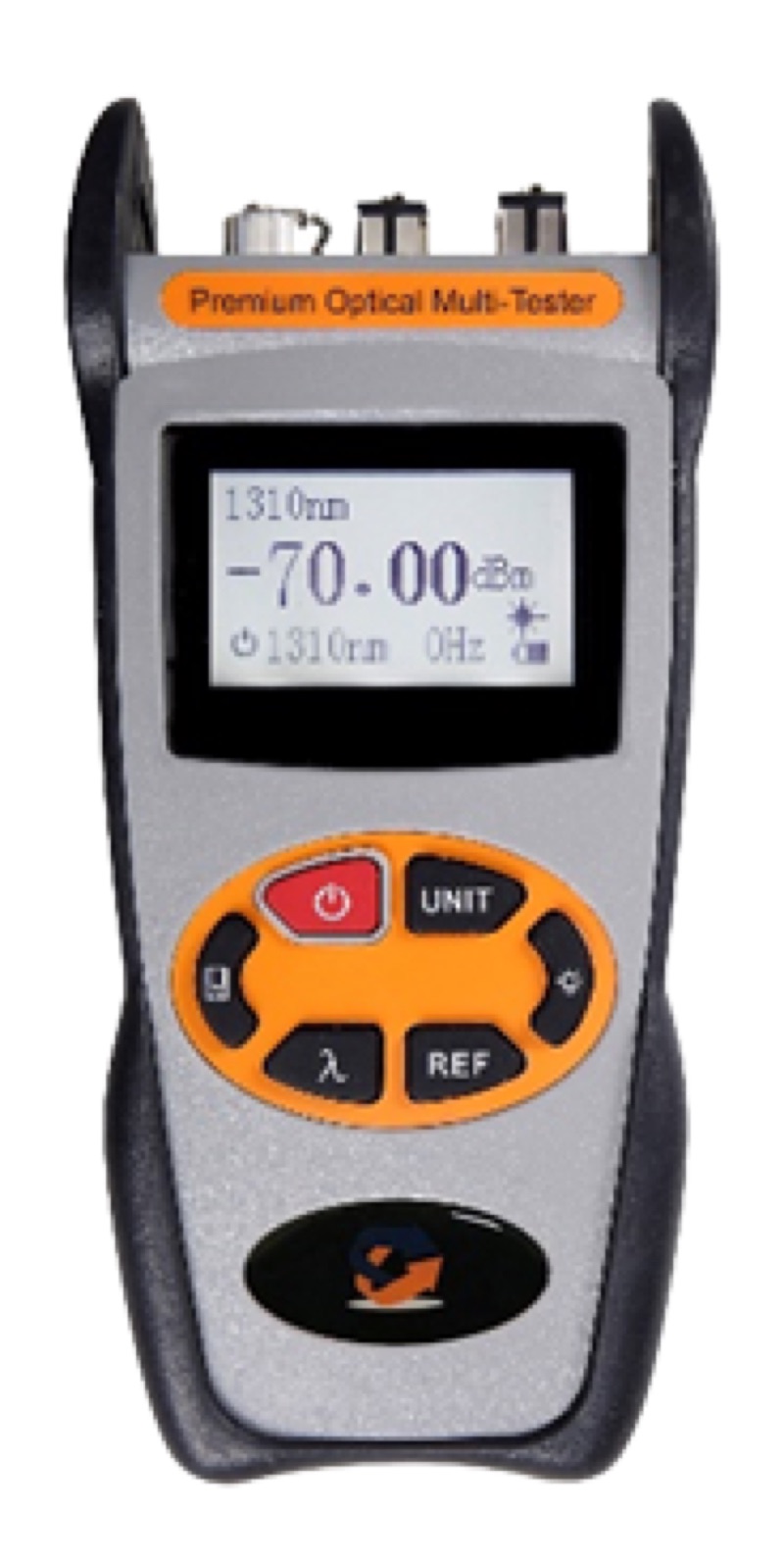
A power meter measures absolute optical power in dBm at one end of a fiber. Pair it with a calibrated light source at the other end and you get end-to-end insertion loss directly: source power minus received power equals total link loss. The measurement is absolute and traceable to optical power standards.
An OTDR sends pulses into the fiber and measures backscatter from one end. It produces a trace of loss versus distance, identifying every connector, splice, bend, and break along the route. The OTDR estimates loss from backscatter analysis -- not a direct absolute measurement.
For the foundational explanations, see OTDR testing basics and best fiber optic power meters.
Side by Side: OTDR vs Power Meter
| Capability | OTDR | Power Meter + Source |
|---|---|---|
| End-to-end loss | Estimated from backscatter | Direct absolute measurement |
| Loss accuracy | +/- 0.1 to 0.3 dB | +/- 0.05 dB or better |
| Per-event loss | Yes, per splice and connector | No, total only |
| Fault location | Yes, distance to break | No, only detects pass/fail |
| Number of techs needed | One (one end) | Two (one at each end) |
| Test time per fiber | 3-5 min per wavelength | 30 sec per wavelength |
| Live PON measurement | No (damages OLT) | Yes (with PON power meter) |
| Acceptance documentation | Per-event trace records | Loss certification value |
| Equipment cost | From $579.99 for a mini OTDR | From $339.99 for a basic meter |
| Reflectance measurement | Yes | No |
When to Use an OTDR
Locating Faults
The OTDR is the only practical tool for finding where a fault is on a long dark fiber. The trace gives you the distance to the break or high-loss event, so the field crew knows exactly where to dig, climb, or open a closure. A power meter only tells you "this link fails." It does not tell you which of 30 splices on a 50 km route has the problem.
Documenting Splice Quality
Acceptance testing on new construction requires per-splice loss documentation. Each fusion splice must be measured and recorded individually -- typically passing if loss is below 0.1 dB. A power meter cannot resolve individual splices; it gives you total link loss only. The OTDR walks each splice and records its loss value for the test report.
Verifying Reflectance
Reflectance is a critical parameter on FTTH and PON networks because high-reflectance events cause Raman scattering, FEC errors, and PON downstream degradation. Most carrier specs require reflectance better than -40 dB throughout the link. Only an OTDR measures reflectance. Power meters cannot.
Characterizing Long Routes
For backbone fiber over 30 km, the OTDR gives you a permanent record of every splice closure and connector that future maintenance can reference. When a fault occurs years later, the original trace tells you what was there originally and what changed.
Pre-Service Verification
Before activating a new long-haul link, the OTDR catches problems that the power meter would miss: a hidden macrobend in a splice closure, a marginal connector that will fail under load, a contaminated fusion splice that passes loss budget but reflects too much.
When to Use a Power Meter
Routine FTTH Drop Verification
For a 200-meter drop from the splitter to the ONT, a power meter measurement is sufficient. The link is short, has few events (a connector at each end and one or two splices), and the only number that matters is whether the ONT will see enough power to authenticate. The Optical Power Meter LC handles this for $339.99.
Live PON Network Testing
An OTDR cannot be connected to a live PON fiber -- the high-power pulses will damage the OLT receiver. PON power meters with wavelength-selective filters measure the optical power of each PON wavelength on a live fiber without disturbing service. The XGS/GPON Power Meter measures GPON and XGS-PON downstream and upstream simultaneously on a live fiber.
Loss Certification
For acceptance testing, the absolute end-to-end loss number comes from the power meter. Even when an OTDR trace is also required, the loss value certified for the link is typically the power meter measurement because of its better accuracy. The OTDR documents the events; the power meter certifies the loss budget.
ONT Activation Verification
When an ONT will not authenticate, the first test is a downstream power measurement at the ONT location. Is the OLT signal arriving with enough power? If yes, the problem is the ONT or its configuration. If no, the problem is in the fiber. This is a 30-second power meter measurement that resolves most "ONT broken" trouble tickets.
Quick Sanity Checks
Many fiber problems can be ruled in or out with a 30-second power measurement before going to the trouble of setting up an OTDR. Always start with the power meter; reach for the OTDR only when the power meter says something is wrong and you need to know what.
Decision Framework: Which Tool for Which Task
- Customer reports slow internet: Power meter at the ONT. Verify downstream power is in spec. If low, then OTDR to locate the fault.
- New FTTH drop activation: Power meter for end-to-end loss verification. OTDR optional for documentation.
- New backbone fiber acceptance: Both. OTDR for per-event documentation, power meter for end-to-end loss certification.
- Locating a buried fiber break: OTDR for distance to break, then VFL or boots-on-the-ground at that distance.
- Routine OLT health check: PON power meter. Verify downstream power at the customer side.
- Splice loss verification on a new install: OTDR. Per-splice loss is the only metric that matters.
- Patch panel verification in a data center: Power meter with light source. Loss budget is what the equipment cares about.
- PON network commissioning: PON power meter + OTDR. Power meter for live-network readings, OTDR for splice closure documentation done before service activation.
PON Networks: A Special Case
PON networks add complications that change the OTDR vs power meter calculus. Multiple wavelengths share the same fiber simultaneously, and the network is typically in service when troubleshooting calls happen.
Why Standard OTDRs Fail on Live PON
An OTDR launches high-power optical pulses. On a live PON network with an active OLT, those pulses interfere with downstream traffic and can damage the OLT receiver. Standard OTDR testing requires the network to be administratively disabled, which means coordinating an outage.
1625nm OTDRs for In-Service Testing
OTDRs that operate at 1625nm can test live PON fibers because 1625nm falls outside GPON, XGS-PON, and 25G-PON operating wavelengths. The OTDR pulses do not interfere with active downstream or upstream traffic. This requires a 1625nm-capable OTDR (typically full-featured, not mini class) plus a wavelength-blocking filter to prevent the OTDR from receiving interference from downstream traffic.
PON Power Meters for Live Verification
The simpler solution for live PON verification is a PON power meter. The XGS/GPON Power Meter uses wavelength-selective filters to measure each PON wavelength independently on a live fiber. Connect, read the downstream and upstream power levels, disconnect, done -- no service disruption.
The Combined Test Workflow
For new construction acceptance, the standard workflow uses both instruments in sequence:
- OTDR bidirectional trace at both wavelengths. Documents every event with location and per-event loss. Captures reflectance for all reflective events. Identifies any out-of-spec splice or connector for rework.
- Power meter measurement at both wavelengths. End-to-end loss in absolute dB. This is the certification value that goes on the acceptance test sheet.
- Connector inspection with a fiber scope. Endface photos of every connector for the documentation package. Inspect, clean, re-inspect.
The OTDR catches what the power meter cannot see (per-event detail, reflectance, fault location). The power meter catches what the OTDR cannot measure precisely (absolute end-to-end loss). The combination gives you a complete picture of link health.
Cost and ROI: Building a Test Kit
Test equipment is a capital investment. Understanding the cost of each tool relative to the time it saves helps prioritize purchases for new fiber crews.
Power Meter First
For a tech doing FTTH installation work, a power meter is the highest-value first purchase. Starting at $339.99 for the Optical Power Meter LC, it pays for itself by eliminating "is the link working?" questions on every job. The XGS/GPON Power Meter at $484.99 covers GPON and XGS-PON troubleshooting.
OTDR Second
Once the basic test workflow is in place, an OTDR enables jobs the power meter alone cannot handle: fault location on long fiber, per-splice loss documentation, acceptance testing for new construction. The mini-class Fiber Ranger OTDR handles FTTH and access fiber up to 30-40 km, which covers the majority of FTTH installer work.
When to Rent vs Buy
For long-haul fiber testing on rare projects, renting a full-featured OTDR is often more economical than buying. Rental rates of $150-300 per day mean a 5-day project costs $1,500 vs $15,000+ to purchase a comparable long-haul instrument. That math is about full-featured OTDRs, not about a mini like the Fiber Ranger, which most FTTH crews are better off owning outright. Buy what you use weekly; rent what you use occasionally.
Practical Test Order: Power Meter First, OTDR Second
On a real fiber troubleshooting call, the sequence of tests should escalate from cheapest and fastest to most expensive and slowest. The power meter usually answers the question; reach for the OTDR only when it cannot.
- Visual fault locator continuity check -- 30 seconds. Catches obvious breaks and unmated connectors.
- Power meter measurement at the customer end -- 1 minute. Is the optical signal arriving with enough power? Yes means the fiber is fine and the problem is electronic. No means the problem is in the fiber.
- Power meter at the source end -- 1 minute. Confirms the source is transmitting at expected power. If yes, the loss is in the fiber.
- Connector inspection -- 2 minutes per connector. Most "fiber" problems turn out to be dirty or damaged connectors at the patch panel.
- OTDR trace -- 10 minutes. Only if the previous steps did not isolate the fault. Localizes the problem to a specific point along the route.
Using this sequence resolves about 80% of fiber troubleshooting calls without ever launching an OTDR. The OTDR comes out for the hard cases where simpler tests failed.
Equipment Recommendations
For a complete fiber test kit:
- OTDR: Fiber Ranger OTDR. Compact, FTTH-focused, supports both common single-mode wavelengths.
- Optical power meter: Optical Power Meter LC for non-PON work, or the XGS/GPON Power Meter for FTTH PON work.
- PON-specific: PON Power Meter Pro for multi-generation PON networks (XGS-PON + NG-PON2).
- Inspection: WiFi Fiber Microscope with appropriate inspection tips.
- Visual continuity: VFL Pen 5km for short-fiber break location.
For more on power meter selection, see our power meter buying guide.
Calibration: The Hidden Cost of Both Tools
Both OTDRs and power meters require periodic calibration to produce traceable measurements. The calibration cycle is a real cost most contractors underestimate when budgeting test equipment.
Power Meter Calibration
Annual calibration against a NIST-traceable reference is the standard. Cost ranges $150-300 per meter. Without current calibration, your loss numbers may not be acceptable on contracts requiring traceable measurement.
OTDR Calibration
OTDR calibration is optical (loss accuracy) and distance (range accuracy). Annual cycle, $300-600 per unit. The optical loss calibration matters most -- distance accuracy on modern OTDRs rarely drifts.
Budgeting for Calibration
For a contractor with a power meter, light source, and OTDR, expect $700-1,200 per year in calibration costs. Build this into your equipment overhead. Calibration that lapses mid-project can disqualify the test report.
Power Meter + Light Source: The Other Half
A power meter measures incoming light, but it needs a calibrated light source at the other end of the link to give you a meaningful number. The pair is what techs call insertion loss test set (ILTS) or just "the light source and power meter set."
Reference Setup
Before testing a link, reference the meter and source. Connect them with a single short patch cable, set the meter to absolute power (dBm), then set "reference" or "zero" to capture the source's output power as the baseline. From that point forward, the meter reads insertion loss in dB relative to the reference.
One-Cord, Two-Cord, Three-Cord References
The TIA-526-7 and IEC 61280-4-2 standards define three reference methods. One-cord is the most common in FTTH (the simplest, but it includes the connector loss between the source and the link's first connector in the reference). Two-cord and three-cord methods isolate the source connector and produce more accurate end-to-end loss numbers but require more cables and inspection cycles. For routine FTTH, one-cord is the standard.
Single Wavelength vs Dual Wavelength
Many modern light sources output 1310 and 1550 simultaneously, and modern power meters detect both wavelengths in one shot. This cuts test time in half compared to single-wavelength sources where you have to test, change wavelength, test again. For FTTH at scale, dual-wavelength is worth the cost.
What Goes in a Final Test Report
The deliverable on most fiber projects is a test report. Knowing what to include keeps you out of disputes and protects you when problems appear later.
Per-Link Power Meter Results
For every link in the project, the report should show the measured loss at 1310 and 1550 nm, the loss budget, the pass/fail status, the date, the technician, and the reference method used. This is the contractual deliverable.
OTDR Traces for Faulted or Long Links
For any link that failed the power meter test, the OTDR trace shows where the problem is and proves the fault is fixable. For backbone links that exceed the simple FTTH model, OTDR traces document each splice and connector individually so future troubleshooting starts with a baseline.
The Photo Inventory
Splice closure photos, fiber pathway photos, and connector inspection photos turn a paper test report into something a future tech can use to find the splice they need to fix. Most test report software now supports embedded photos.
Browse Fiber Test Equipment
OTDRs, power meters, light sources, and inspection tools for complete fiber link characterization, certification, and troubleshooting.