What Is Ribbon Fiber Cable
A ribbon fiber is a flat assembly of 12 individual fibers held side-by-side in a thin matrix material. The matrix bonds the fibers in a fixed planar geometry, with consistent spacing and alignment. A ribbon cable typically contains multiple ribbons stacked or coiled inside an outer jacket -- a 144-fiber ribbon cable holds 12 ribbons of 12 fibers each.
Ribbon construction was developed for high-fiber-count applications where bundling 144 or 288 fibers as individual loose tubes would create a cable too large to handle. Ribbon packs more fibers into less cross-sectional area and enables mass splicing.
Ribbon cable is dominant in:
- Data center backbone and aggregation
- Central office trunk runs
- Long-haul OSP backbone
- Hyperscale and cloud provider networks
- Submarine and festoon cable
Ribbon cable is rare or absent in:
- FTTH distribution and drop networks
- Premises horizontal cabling
- Building risers under 24 fibers
How Ribbon Fusion Splicing Works
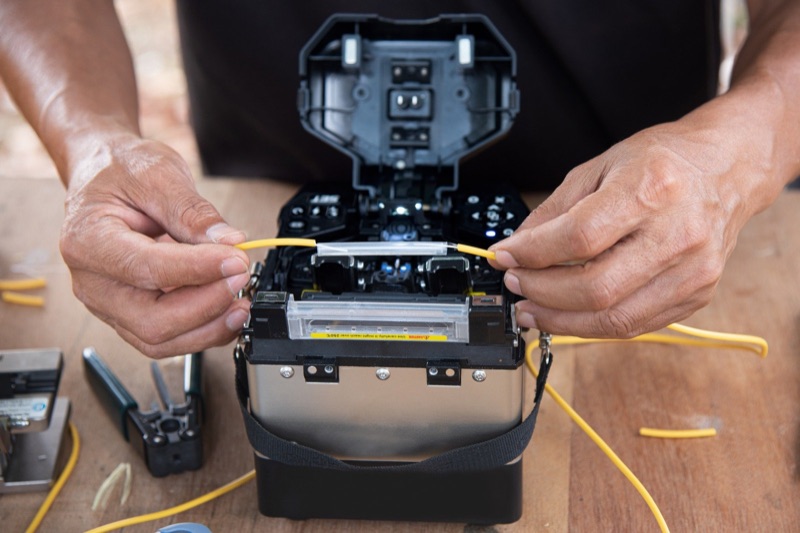
A ribbon fusion splicer aligns and fuses all 12 fibers in a ribbon simultaneously. The process is essentially the same as single-fiber splicing, but at 12x the scale.
Ribbon-Specific Equipment
Ribbon splicing requires equipment designed for the ribbon format:
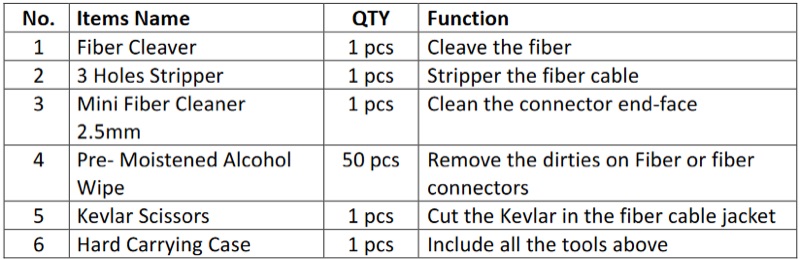
- Ribbon splicer: Wide v-grooves that hold all 12 fibers, cameras with field of view to image the entire ribbon, electrode geometry that delivers even arc energy across the ribbon width.
- Ribbon stripper: Removes the matrix material and individual fiber coatings in a single step. Hot-jacket strippers use heat to soften the matrix; mechanical strippers use precision blades.
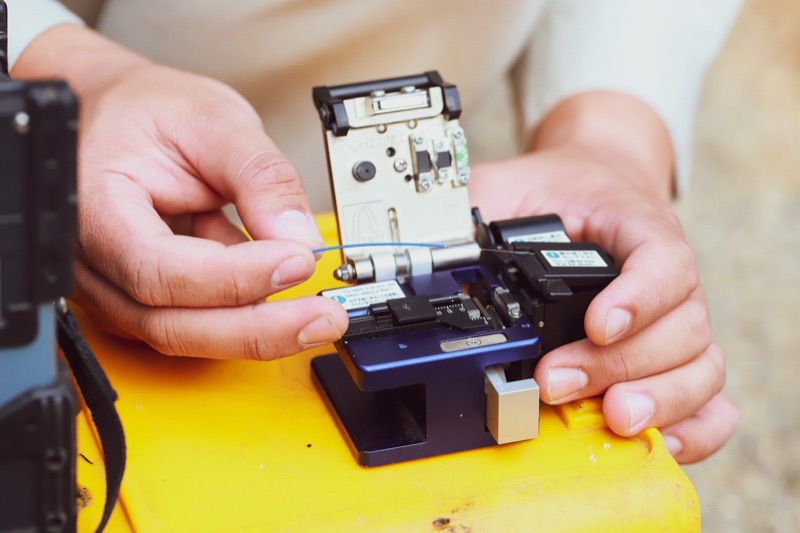
- Ribbon cleaver: Cleaves all 12 fibers simultaneously with consistent angle on each. Single-fiber cleavers cannot handle ribbon.
- Ribbon heat-shrink sleeves: Wider, longer sleeves that protect the entire ribbon splice region.
- Ribbon-capable heat oven: Most ribbon splicers have a built-in ribbon oven; the wider sleeve will not fit in a single-fiber oven.
The Splice Process
The procedure mirrors single-fiber splicing but with ribbon-scale prep:
- Strip the cable jacket and identify the target ribbon by color
- Strip the ribbon matrix and individual fiber coatings
- Clean all 12 bare fibers
- Slide a ribbon protection sleeve onto one side
- Cleave all 12 fibers simultaneously with the ribbon cleaver
- Load both ribbons into the splicer fiber holders
- Run the splice cycle (typically 10-15 seconds for the entire ribbon)
- Apply the ribbon heat-shrink sleeve in the heater
- Verify with bidirectional OTDR on each fiber
Time Comparison: How Much Faster Is Ribbon
The big advantage of ribbon splicing is throughput on high-fiber-count cables. Here is what the math looks like in practice.
| Cable Size | Single-Fiber Splices | Ribbon Splices | Time Saved |
|---|---|---|---|
| 12 fibers | 12 splices (~30 min) | 1 splice (~3 min) | ~27 min |
| 24 fibers | 24 splices (~60 min) | 2 splices (~6 min) | ~54 min |
| 48 fibers | 48 splices (~2 hr) | 4 splices (~12 min) | ~1.8 hr |
| 96 fibers | 96 splices (~4 hr) | 8 splices (~24 min) | ~3.5 hr |
| 144 fibers | 144 splices (~7 hr) | 12 splices (~36 min) | ~6.4 hr |
| 288 fibers | 288 splices (~14 hr) | 24 splices (~72 min) | ~12.8 hr |
The numbers assume 2.5 minutes per single-fiber splice and 3 minutes per ribbon splice (slightly longer due to more complex prep). Real-world times vary, but the ratio holds: ribbon splicing is roughly 10x faster on the splice operations themselves.
Note that other portions of the closure work -- opening the cable, organizing fibers, sealing the closure -- take the same time regardless of splice method. So total closure time for a 144-fiber splice closure might be 9 hours single-fiber vs 3 hours ribbon, not 7 hours vs 36 minutes.
Cost Comparison
Ribbon splicing equipment costs roughly 3-4x more than single-fiber equipment. The decision is whether the time savings justify the equipment investment.
Equipment Costs
- Single-fiber splicer: The QBL Fusion Splicer at $2,349.99 plus a single-fiber cleaver at $299.99 = $2,650 total.
- Ribbon splicer: The QBL Ribbon Fusion Splicer at $8,799.99 plus a ribbon cleaver and ribbon stripper = roughly $10,000-$12,000 total.
When the Investment Pays Back
If you splice high-fiber-count cables regularly, the ribbon splicer pays back quickly in labor savings. A team that splices three 144-fiber closures per week saves roughly 20 labor hours per week with a ribbon splicer -- 1,000+ hours per year. At even modest fully-loaded labor rates, that is far more than the equipment cost premium in the first year.
If you only encounter ribbon cable occasionally (a few closures per year), the investment is harder to justify. Renting a ribbon splicer for the specific job, or breaking the ribbon into individual fibers and splicing on a single-fiber machine, may make more sense.
Splice Quality: Are Ribbon Splices As Good
Modern ribbon splicers achieve the same splice loss as single-fiber splicers when both use core alignment. The mass splice does not compromise quality.
How Ribbon Splicers Maintain Quality
The splicer uses individual core alignment on each fiber in the ribbon. Cameras image the ribbon from two angles, image processing identifies each fiber core position, and the splicer aligns each pair of cores using motorized stages that move the ribbon as a unit while compensating for any individual fiber misalignment in the ribbon matrix.
The fusion arc itself is wider than a single-fiber arc, designed to deliver even thermal energy across all 12 fibers simultaneously. The arc parameters are calibrated for the ribbon configuration to ensure uniform melting.
Loss Verification
Each fiber in a ribbon splice is verified individually with the OTDR. The 12 fibers all have measured splice losses, and any single fiber that exceeds the acceptance threshold can fail the entire ribbon -- requiring a re-splice on all 12. This is the trade-off: one bad cleave or one piece of debris ruins the entire ribbon, not just one fiber.
For acceptance criteria details, see fusion splice loss budget explained.
When to Use Each Method
Use Single-Fiber Splicing When:
- You work primarily on FTTH drop cable, distribution cable, and PON networks
- You repair damaged cables (cuts, cable damage), where ribbon splicing is impractical
- You splice premises cabling and building risers under 24 fibers
- You need a portable splicer for field use in tight spaces (poles, manholes, attics)
- Your typical cable size is under 12 fibers per cable
Use Ribbon Splicing When:
- You work in data centers or central offices where ribbon cable is dominant
- Your typical cable size is 48 fibers or more
- You splice backbone, trunk, or long-haul cables where labor cost dominates
- You work in a fixed splicing location (table or bench) rather than aerial or in-manhole
- You support hyperscale data center expansion or telecom backbone construction
Side-by-Side Feature Comparison
| Feature | Single-Fiber | Ribbon |
|---|---|---|
| Fibers per arc | 1 | Up to 12 |
| Splicer cost | $2,000-3,000 | $8,000-12,000 |
| Cleaver cost | $200-500 | $1,500-3,000 |
| Splice loss per fiber | 0.02-0.05 dB | 0.02-0.05 dB |
| Portability | Highly portable | Bench/table only |
| Prep complexity | Simple | Requires hot-jacket stripper |
| Closure organization | One sleeve per fiber | One sleeve per ribbon |
| Best for | FTTH, repairs, premises | Backbone, DC, CO, trunk |
Hybrid Approaches
Ribbon Splicer Splicing Single Fibers
Most ribbon splicers can be reconfigured for single-fiber work using a single-fiber holder accessory. This is useful for shops that do mostly ribbon work but occasionally need single-fiber capability for repair or premises work. The single-fiber configuration on a ribbon machine is fully capable -- just larger and less portable than a dedicated single-fiber splicer.
Single-Fiber Splicing of Ribbon Cable
If you encounter ribbon cable occasionally and do not have a ribbon splicer, you can break the ribbon down into individual fibers and splice them one at a time on a single-fiber splicer. The matrix material can be removed manually with appropriate strippers. This works fine for low-volume ribbon work but is impractical for routine ribbon splicing because of the time penalty.
Field Splice Closures with Mixed Cable
Some splice closures join different cable types -- for example, a ribbon backbone splicing into individual loose-tube distribution cable. In these cases you can splice ribbon-to-individual using either method: break the ribbon down to individual fibers and use a single-fiber splicer for all splices, or use a ribbon splicer with a single-fiber adapter for the individual fiber splices.
Frequently Asked Questions
What is the difference between ribbon and single-fiber fusion splicing?
Single-fiber fusion splicing splices one fiber at a time. Ribbon fusion splicing splices an entire ribbon (typically 12 fibers) in a single arc cycle. Ribbon splicing is much faster on high-fiber-count cables but requires a ribbon-capable splicer, ribbon-specific cleaver, ribbon stripper, and ribbon protection sleeves. Single-fiber splicing is the right choice for FTTH drop work and any cable with under 12 fibers.
How much faster is ribbon splicing than single-fiber splicing?
A 12-fiber ribbon splice takes about the same time as a single-fiber splice. On a 144-fiber cable, ribbon splicing takes 12 splices instead of 144. That cuts splice time from approximately 7 hours to 35 minutes for the cable alone -- roughly 12x faster.
Can a ribbon splicer also splice single fibers?
Yes, most ribbon splicers can also splice single fibers using a single-fiber holder accessory. However, ribbon splicers are bench-top machines designed for splicing tables, not portable field work. If your work is mostly single-fiber FTTH or repair work, a dedicated single-fiber splicer is more practical.
Can I splice a ribbon cable as individual fibers on a single-fiber splicer?
Yes, you can break a ribbon down into individual fibers and splice them one at a time on a single-fiber splicer. The result is the same low-loss splice, but it takes 12 times longer per ribbon and produces a less organized splice tray. This is acceptable for low-volume ribbon splicing or as a backup when a ribbon splicer is unavailable.
What is the splice loss difference between ribbon and single-fiber splicing?
There is essentially no difference in splice loss between ribbon and single-fiber fusion splicing when both use core alignment. Modern ribbon splicers individually align each core in the ribbon before the simultaneous arc, producing 0.02-0.05 dB per fiber -- the same as single-fiber splices.
Related Reading
- Best Fusion Splicers for FTTH Work in 2026 -- buying guide covering palm, full-size, and ribbon splicers.
- Fusion Splicer Buying Guide -- spec-by-spec breakdown of what to look for.
- How to Perform a Fusion Splice -- step-by-step field procedure.
Shop Fusion Splicers
Single-fiber and ribbon fusion splicers from QBL for FTTH, OSP, and data center fiber work.