Why Splice Loss Matters in a Link Budget
Every component in an optical fiber link reduces the signal power. Connectors lose 0.15-0.5 dB. Fiber attenuates the signal at 0.2 dB/km at 1310nm and 0.15 dB/km at 1550nm. Each splice adds another small amount of loss. Add it all up and you get the total link loss in dB.
The transceiver at each end of the link has a transmit power and a receiver sensitivity. The difference between transmit power and receiver sensitivity (minus a safety margin) is the optical power budget. If total link loss exceeds the power budget, the receiver does not get enough light to recover the signal -- the link does not work.
This is why every dB matters. A 0.5 dB sloppy splice that gets through QA can be the difference between a working link and a non-working link, especially on long PON splits where the budget is already tight.
Industry Standards for Splice Loss
Several standards bodies define acceptance criteria for fusion splices. The numbers are similar across organizations because they all reflect the practical limits of modern fusion splicing technology.
Telcordia GR-1093 (Bellcore)
The dominant standard for North American telecom OSP work. GR-1093 specifies:
- Maximum individual splice loss: 0.1 dB
- Average splice loss across a link: 0.05 dB
- Measurement method: bidirectional OTDR, averaged
IEC 61753 / IEC 61755
The international standard for fiber optic interconnect performance. Loss thresholds are similar to GR-1093, with the same 0.1 dB single-splice acceptance threshold.
TIA-568 (Premises Cabling)
For commercial and data center cabling, TIA-568 specifies maximum splice loss of 0.3 dB. This is more permissive than telco standards because premises cabling typically has shorter link lengths and looser power budgets.
FTTH Council / GPON Standards
FTTH operators typically follow Telcordia GR-1093 for splice acceptance. Some operators specify tighter internal targets (0.05 dB per splice average) on long-distance feeder fiber to preserve budget for higher PON splits.
What Determines Fusion Splice Loss
Several factors contribute to the actual loss at a fusion splice point. Some are under the technician's control; others are inherent to the fibers being spliced.
Cleave Quality
The cleave angle is the single biggest controllable factor in splice quality. A cleave angle under 0.5 degrees produces consistent low-loss splices. Above 1 degree, splice loss climbs rapidly. A worn cleaver blade or improper technique is the most common cause of high splice loss in field work.
Fiber Cleanliness
Contamination on the bare fiber gets vaporized by the fusion arc and re-deposited as carbon or particulate inclusions in the splice. Skin oils, dust, and coating residue all cause measurable loss. Always clean with 99% IPA before cleaving.
Core Concentricity
Manufactured fiber has a small offset between the core (light-carrying region) and the cladding (outer glass). This offset is typically under 0.5 micrometers but varies between manufacturers and lots. Core-alignment splicers compensate for the offset by aligning the actual cores; cladding-alignment splicers cannot, so core offset directly increases splice loss. See core vs cladding alignment splicers for the technical details.
Mode Field Diameter Mismatch
Different fiber types or different manufacturers' fibers may have slightly different mode field diameters at the operating wavelength. The mismatch creates an unavoidable splice loss even with perfect alignment. This is why OSP networks try to use the same fiber type and manufacturer throughout a route.
Arc Energy Calibration
The fusion arc must deliver enough energy to fully melt both fiber end-faces but not so much that the glass deforms or the core is disturbed. Splicers run an arc calibration routine that adjusts arc current for atmospheric conditions. An out-of-calibration splicer produces inconsistent splice losses.
Fiber Type Compatibility
Splicing single-mode to multimode (or vice versa) creates a large unavoidable loss because the mode field diameters and core sizes do not match. Splicing standard SMF-28 to bend-insensitive fiber (G.657) usually produces clean splices because the mode field diameters are close. Always use the correct splicing program for the fiber types being joined.
Splicer Estimated Loss vs OTDR Measurement
The splicer displays an estimated splice loss after the cycle completes. This number is useful as a go/no-go indicator in the field but is not a real measurement. Understand the difference.
How the Splicer Estimates Loss
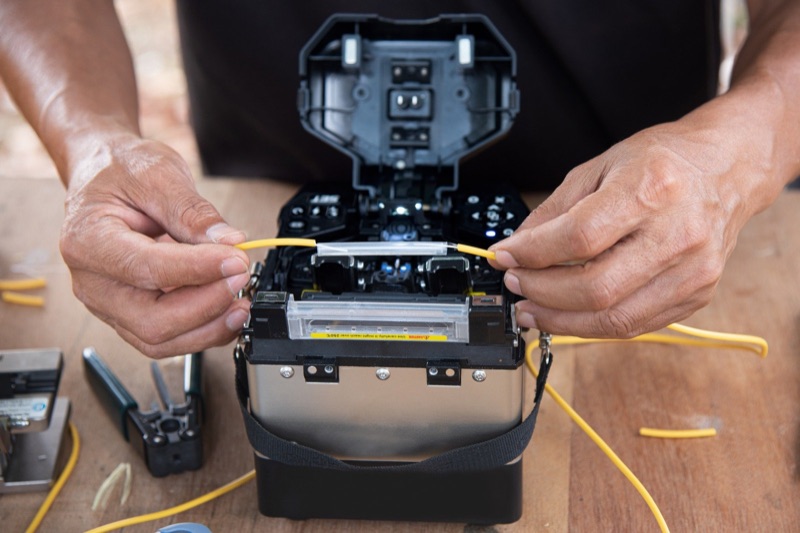
The fusion splicer takes images of the splice from two perpendicular angles after the arc. Image processing software analyzes the geometry of the splice -- core alignment, cladding alignment, deformation, surface tension effects -- and applies a profile algorithm to estimate the loss based on the visible geometry. The estimate is typically accurate to within 0.02-0.03 dB on good splices.
How the OTDR Measures Loss
An OTDR sends optical pulses down the fiber and measures the backscattered light returning at each point along the fiber. At a splice point, the backscatter level shifts up or down. The OTDR calculates splice loss from the shift in backscatter level. This is an actual measurement of how the splice affects light propagation, not an estimate based on visible geometry.
Why They Disagree
The splicer estimate cannot account for invisible factors like core concentricity offset, mode field mismatch, or arc-induced refractive index changes. The OTDR measurement captures the true effect on the light. A splice can look perfect on the splicer image and measure 0.15 dB on the OTDR, or look slightly imperfect and measure 0.02 dB. Use the splicer estimate as a quick field check; use the OTDR for final acceptance. For OTDR fundamentals, see OTDR basics.
Why Bidirectional OTDR Averaging Matters
OTDR splice measurements are inherently directional. The same splice will measure differently when shot from each direction. The bidirectional average is the true splice loss; single-direction measurements are not reliable.
The Backscatter Coefficient Problem
Different fibers have slightly different Rayleigh backscatter coefficients. When you shoot an OTDR across a splice, you see the backscatter from the fiber on each side. If the backscatter coefficients differ, the measured "splice loss" includes a contribution from the difference in backscatter. Shooting from the other direction inverts the contribution. Average both directions and the artifact cancels.
Gainers and Losers
If the second fiber has higher backscatter than the first, the OTDR can measure apparent gain (negative loss) at the splice. This is called a gainer. It is impossible -- a passive splice cannot amplify light -- but it appears in the trace because of the backscatter coefficient difference. A gainer in one direction is matched by a corresponding higher loss in the opposite direction. The bidirectional average gives the true loss.
How to Average
Measure the splice loss from each direction with the OTDR. The true splice loss is (Loss_AtoB + Loss_BtoA) / 2. If your OTDR has a built-in bidirectional analysis function, it will perform this calculation automatically when you load both traces. Most modern OTDRs including the Fiber Ranger OTDR support bidirectional trace analysis.
Splice Loss Targets by Application
| Application | Acceptance Threshold | Typical Achieved |
|---|---|---|
| FTTH drop / distribution | 0.1 dB | 0.02-0.05 dB |
| OSP feeder / backbone | 0.1 dB max, 0.05 avg | 0.02-0.04 dB |
| Long-haul / submarine | 0.05 dB | 0.01-0.03 dB |
| Data center / premises | 0.3 dB (TIA-568) | 0.02-0.05 dB |
| Multimode (OM3/OM4/OM5) | 0.15 dB | 0.05-0.1 dB |
| SM-MM hybrid (avoid) | Not recommended | 3-15 dB (high loss) |
Calculating a Fiber Link Budget
The total link budget calculation sums every loss between the transmitter and receiver. Compare the total to the optical power budget of the transceivers to verify the link will work.
Components of Link Loss
- Connectors: Count the number of mated connector pairs along the link. Allocate 0.3 dB per pair for SC/UPC, 0.5 dB for SC/APC, 0.5 dB for LC. (See SC/APC vs UPC for connector loss details.)
- Splices: Count fusion splices in the link. Allocate 0.1 dB per splice for design margin (actual loss is typically lower).
- Fiber attenuation: Multiply length in km by the per-km attenuation: 0.35 dB/km at 1310nm, 0.25 dB/km at 1550nm for SMF-28. (For multimode see single-mode vs multimode.)
- PON splitter loss: For FTTH, add splitter loss: 1x4 = 7 dB, 1x8 = 10 dB, 1x16 = 13 dB, 1x32 = 16.5 dB.
- Safety margin: Add 2-3 dB margin for aging, repairs, and temperature variation.
Example: GPON Link Budget
OLT transmit power: +5 dBm. ONT receiver sensitivity: -28 dBm. Power budget = 33 dB.
- OLT pigtail to feeder: 0.3 dB
- Feeder fiber 8 km at 1490nm: 8 x 0.21 = 1.7 dB
- 3 splices (feeder closures): 3 x 0.1 = 0.3 dB
- 1x32 splitter: 16.5 dB
- Distribution fiber 2 km: 2 x 0.21 = 0.4 dB
- 2 splices (distribution closures): 2 x 0.1 = 0.2 dB
- Drop fiber 0.3 km: 0.3 x 0.21 = 0.06 dB
- 1 drop splice: 0.1 dB
- ONT connector: 0.3 dB
- Safety margin: 3 dB
Total: ~22.9 dB used, 10.1 dB headroom. Link is well within budget. If splices were averaging 0.4 dB instead of 0.1 dB, the additional 1.8 dB would still fit in the 10.1 dB headroom -- but on a longer feeder run, sloppy splicing rapidly eats the budget.
Tools for Splice Loss Verification
Splice loss verification requires testing in the field. The minimum field test is bidirectional OTDR; full link certification adds insertion loss measurement with a power meter and source.
OTDR for Splice-by-Splice Loss
An OTDR like the Fiber Ranger OTDR shows every splice and connector along the link as discrete events with measured loss values. This is the primary tool for splice loss verification on OSP and FTTH installations.
Power Meter and Source for End-to-End Loss
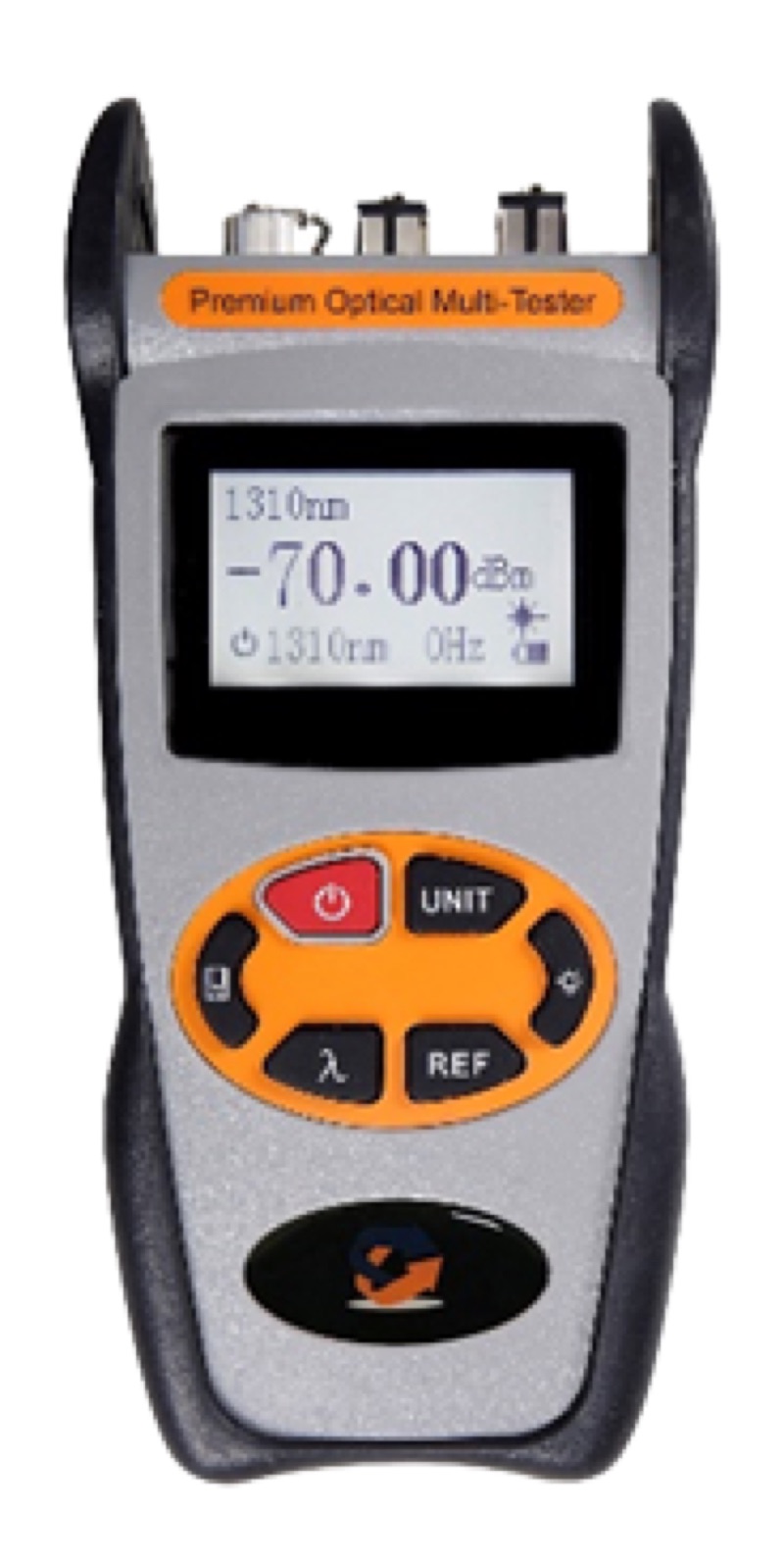
An optical power meter and a stable light source measure total link loss between any two points. Use this to certify the total link meets the power budget. The Optical Power Meter LC handles single-mode and multimode at standard wavelengths.
PON-Specific Power Meters
For live PON troubleshooting, a PON-specific meter measures upstream and downstream power simultaneously without disrupting service. The PON Power Meter Pro handles GPON wavelengths; the XGS-GPON Power Meter covers next-gen XGS-PON. See best fiber optic power meters for the full lineup.
Frequently Asked Questions
What is an acceptable fusion splice loss?
Industry standard acceptance threshold is 0.1 dB or less per splice. Modern core-alignment splicers typically achieve 0.02-0.05 dB. Telcordia GR-1093 specifies 0.1 dB as the maximum for individual splices and 0.05 dB average across all splices in a link. Splices above 0.1 dB should be re-done before sealing the closure.
What is a fiber link budget?
A fiber link budget is the total optical loss allowed between a transmitter and receiver, calculated by summing connector losses, splice losses, and fiber attenuation across the link. The total must stay below the optical power budget defined by the transceivers. For FTTH PON networks, total budget is typically 28-32 dB depending on PON class.
Why does the splicer's estimated loss differ from OTDR measurement?
The splicer's estimated loss is based on image analysis of the splice geometry and is approximate. The OTDR measures real backscattered light and gives a true loss value. They will not match exactly. The splicer estimate is useful for go/no-go decisions in the field; final acceptance is always done with bidirectional OTDR measurement averaged across both directions.
What are gainers in OTDR splice measurements?
A gainer is an OTDR reading that shows apparent gain (negative loss) at a splice point. This is an artifact of measuring across two fibers with slightly different backscatter coefficients. Gainers are not real and do not indicate a bad splice. Bidirectional averaging cancels out the artifact and gives the true splice loss.
How many fusion splices can I have in a fiber link?
There is no fixed limit. The constraint is total link loss against the link budget. At 0.05 dB per splice, you could fit 100 splices in a 5 dB splice loss allocation. Practical FTTH links typically have 4-8 splices total. Long-haul OSP links may have 30+ splices for cable joins every kilometer or two.
Shop Splice Verification Tools
OTDRs, power meters, and inspection scopes for splice loss verification and link certification.