The Three Generations of PON
Most North American FTTH networks today run one of three ITU-T standards. GPON (G.984) is the legacy 2.5G/1.25G standard from the late 2000s, still the dominant deployed base. XGS-PON (G.9807.1) is the symmetric 10G upgrade and the standard most new builds target. 25G-PON (G.9804.3) is the symmetric 25G evolution coming into commercial service for high-density and business-class FTTH.
All three coexist on the same fiber, which lets operators move subscribers from GPON to XGS-PON or 25G-PON one ONT at a time. The catch: each standard uses different wavelengths, which means your test gear has to cover every wavelength you will encounter on the network.
The Headline Numbers
| Spec | GPON | XGS-PON | 25G-PON |
|---|---|---|---|
| ITU-T standard | G.984 | G.9807.1 | G.9804.3 |
| Downstream line rate | 2.488 Gbps | 9.95 Gbps | 24.88 Gbps |
| Upstream line rate | 1.244 Gbps | 9.95 Gbps | 24.88 Gbps |
| Downstream wavelength | 1490nm | 1577nm | 1342nm |
| Upstream wavelength | 1310nm | 1270nm | 1300nm |
| Class B+ budget | 28 dB | 29 dB (N1) | 29 dB (E1) |
| Max split ratio | 1:128 | 1:128 | 1:64 |
| Max reach | 20 km | 20 km | 20 km |
Same fiber, same connectors, same splitters. Different transceivers, different power meters, different OLT and ONT hardware.
Wavelength Plan and Coexistence
The reason all three standards can share fiber is wavelength separation. A passive WDM coexistence module sits between the OLT optics and the splitter, combining and separating the wavelengths so each PON sees only its own light.
GPON Wavelengths
- 1490nm: Downstream data
- 1310nm: Upstream data
- 1550nm: RF video overlay (optional)
XGS-PON Wavelengths
- 1577nm: Downstream data
- 1270nm: Upstream data
25G-PON Wavelengths
- 1342nm: Downstream data
- 1300nm: Upstream data
For a power meter to read live PON power without disrupting service, it must be able to filter individual wavelengths. A general-purpose power meter sees the sum of all wavelengths and cannot tell you what the ONT actually receives at its specific downstream wavelength.
Power Budget Differences
The class budgets look similar (28-29 dB) but the wavelength-dependent fiber loss makes the realized reach different.
At 1310nm (GPON upstream), single-mode fiber attenuates at 0.35 dB/km. At 1577nm (XGS-PON downstream), it attenuates at 0.25 dB/km. So XGS-PON downstream actually has more reach per dB of fiber than GPON upstream. The limiting wavelength on a coexistence network is usually the GPON 1310nm upstream.
For full power budget mechanics, see our FTTH power budget calculation guide.
Test Equipment Required at Each Tier
For GPON-only networks
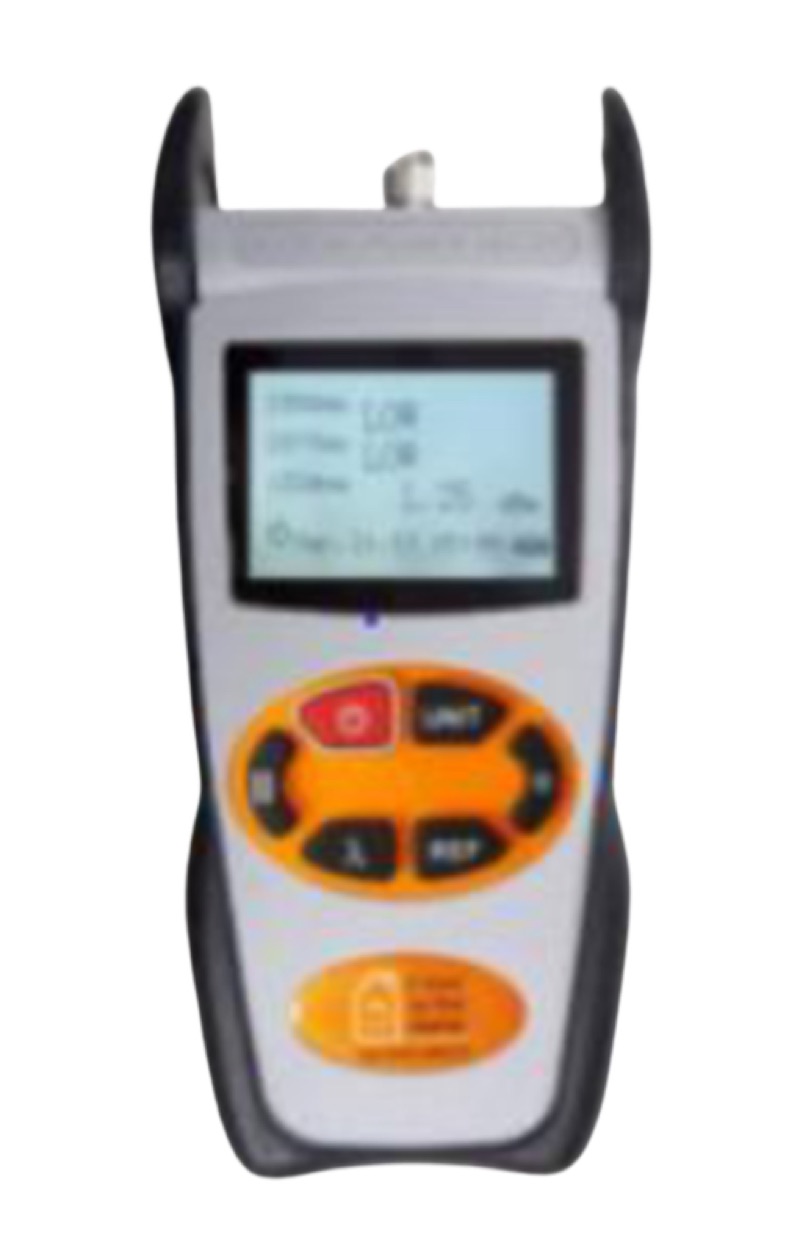
The PON Power Meter Pro covers 1310, 1490, and 1550nm. Adequate for any pure-GPON deployment without a coexistence upgrade path. Cheapest option for crews that only touch GPON.
For GPON + XGS-PON coexistence
The XGS/GPON Power Meter reads 1310, 1490, 1577, and 1270nm. This is the standard meter for any modern FTTH operator running or planning XGS-PON.
For all three (future-proof)
The 25G PON Power Meter adds the 1342nm 25G-PON downstream and the 1300nm upstream while still covering GPON and XGS-PON. If you are buying new test equipment in 2026, this is the right meter to standardize on. See our PON power meter comparison for full feature breakdowns.
OTDR for all three
An OTDR characterizes the fiber itself, not the live PON traffic. The same OTDR works for all three standards as long as it supports the test wavelengths (typically 1310/1550nm for OSP characterization). The Fiber Ranger Mini OTDR handles FTTH OTDR work at any PON tier.
Commissioning Workflow Differences
GPON
- Verify ONT receives 1490nm power between -8 dBm and -28 dBm (B+ class)
- Verify ONT transmits 1310nm at +0.5 to +5 dBm
- Document with PON power meter trace
XGS-PON
- Verify ONT receives 1577nm power between -8 dBm and -28 dBm (N1 class)
- Verify ONT transmits 1270nm at +4 to +9 dBm
- Document with XGS-capable PON power meter
25G-PON
- Verify ONT receives 1342nm power between -8 dBm and -28 dBm (E1 class)
- Verify ONT transmits 1300nm at +4 to +9 dBm
- Inspect every connector with a microscope before final mate (25G is much more sensitive to contamination)
- Document with 25G-capable PON meter
The base workflow is identical. The wavelengths and the power meter change. The connector inspection requirement intensifies as line rate increases.
Connector Considerations
All three PON tiers use SC/APC connectors as the FTTH standard. The 8-degree angled polish minimizes back-reflections, which become more critical as line rates climb. UPC connectors are not acceptable for any current PON deployment in the access network.
For deeper coverage, see our guides on SC/APC vs UPC connectors and single-mode vs multimode fiber.
Stock connector and patch options:
- SM SC/APC Simplex Jumper -- standard splitter pigtail and OLT patch
- LC/APC Jumper -- common ONT and 25G OLT interface
- SC/APC to LC/APC Patch -- bridges OLT to modern ONT pigtails
- SC/APC Hot Fusion Connectors -- field termination
Splitter Choices
Splitters are wavelength-flat across 1260-1650nm, so a single splitter installation supports all three PON tiers without replacement. A 1:32 splitter is the most common deployment ratio for residential FTTH; 1:64 is used in high-density urban builds; 1:128 only for very specific scenarios with extended-reach optics.
For 25G-PON, 1:64 is the practical maximum because the tighter receiver budget penalizes high-loss splitters. Plan splitter ratios with a 25G upgrade in mind even if you are deploying GPON today.
Frequently Asked Questions
Can I use my GPON power meter on an XGS-PON?
You can connect it, but the readings on the XGS wavelengths will be wrong (the meter is not calibrated for 1577 or 1270nm). The 1310 and 1490 readings will still show GPON traffic if it is present. Do not use a GPON-only meter to commission an XGS-PON.
Does 25G-PON require special fiber?
No. Standard G.652.D single-mode fiber works fine. Some 50 km long-reach 25G applications benefit from G.657.A2 bend-insensitive fiber, but standard SMF is the access network norm.
What is a coexistence module?
A passive WDM device that combines and separates the wavelengths of two or more PON standards onto the same fiber. Lets a GPON and an XGS-PON OLT serve different subscribers on the same splitter without interfering.
Should new builds skip XGS-PON and go straight to 25G?
Most operators are still deploying XGS-PON in 2026 because OLT and ONT hardware is much cheaper and more mature. 25G-PON is appearing in select business-class and dense MDU builds. The infrastructure (fiber, splitters, connectors) supports a future 25G upgrade either way.
The Bottom Line
GPON, XGS-PON, and 25G-PON share the same fiber, the same splitters, and the same SC/APC connectors. The differences are in the OLT/ONT optics and the wavelengths they use. For installers, the key takeaway is to buy test equipment that covers all the wavelengths your network will see in the next 3-5 years.
For a single crew handling mixed networks, the 25G PON Power Meter covers everything. For a GPON-only operation that will not migrate, the PON Power Meter Pro is more cost-effective. Whatever you buy, make sure it reads the actual downstream and upstream wavelengths of the PON you are commissioning, not just generic optical power.