How Fiber Optics Work (30-Second Version)
A fiber optic cable transmits data as pulses of light through a glass core. The core is surrounded by cladding -- a layer of glass with a lower refractive index -- that acts as a mirror, keeping light trapped inside the core through a principle called total internal reflection. Light enters one end of the fiber, bounces along the core, and exits the other end, carrying data at the speed of light across distances that copper cable cannot match.
The critical variable is the diameter of that glass core. A smaller core constrains the light into fewer paths. A larger core allows light to travel in many paths simultaneously. This is the fundamental difference between single-mode and multimode fiber, and it determines everything else about how the two types perform.
The Fundamental Difference: Core Diameter
Single-Mode Fiber (OS1, OS2): 9/125 Micrometers
Single-mode fiber has a core diameter of approximately 9 micrometers (sometimes listed as 8.3 micrometers -- the exact value varies slightly by manufacturer). The cladding diameter is 125 micrometers, giving it the designation 9/125. This tiny core is so small that light can only travel through it in a single path -- one mode. There is physically not enough room for light to bounce at multiple angles.
Because the light travels in only one path, there is no modal dispersion (different paths arriving at slightly different times). This means the signal stays clean and sharp over extremely long distances. Single-mode fiber supports transmission distances of 10 to 80+ kilometers depending on the wavelength and transceiver technology, with some long-haul amplified systems reaching thousands of kilometers.
Single-mode fiber uses laser-based transceivers operating at 1310nm and 1550nm wavelengths. These are in the infrared range and are optimized for the wavelengths where glass fiber has the lowest attenuation (signal loss per kilometer).
Multimode Fiber (OM1-OM5): 50/125 or 62.5/125 Micrometers
Multimode fiber has a core diameter of either 50 micrometers (modern OM2/OM3/OM4/OM5) or 62.5 micrometers (legacy OM1). The cladding is 125 micrometers in both cases. This larger core allows light to travel in hundreds of simultaneous paths -- hundreds of modes -- each bouncing through the core at a slightly different angle.
The problem with multiple modes is modal dispersion. Light traveling in a path that bounces at a steep angle covers more physical distance than light traveling straight down the center. Over the length of the fiber, these different path lengths cause the light pulses to spread out in time. Short, sharp pulses at the transmitter become wider, overlapping pulses at the receiver. This limits both the distance and the bandwidth of multimode fiber.
Multimode fiber typically uses VCSEL (Vertical-Cavity Surface-Emitting Laser) transceivers operating at 850nm, with some systems also using 1300nm. VCSELs are cheaper to manufacture than the edge-emitting lasers used in single-mode systems, which is the primary cost advantage of multimode.
Head-to-Head Comparison
| Specification | Single-Mode | Multimode |
|---|---|---|
| Core Diameter | 9 um (OS1/OS2) | 50 um (OM2-OM5) or 62.5 um (OM1) |
| Cladding Diameter | 125 um | 125 um |
| Maximum Distance | 10-80+ km (unamplified) | 100-550 m (depends on speed and OM grade) |
| Typical Wavelengths | 1310 nm, 1550 nm | 850 nm, 1300 nm |
| Transceiver Type | Edge-emitting laser, DFB laser | VCSEL (850nm) |
| Bandwidth | Virtually unlimited (THz range) | 500-4700 MHz*km (depends on OM grade) |
| Cable Cost | Comparable to multimode | Comparable to single-mode |
| Transceiver Cost | Higher (gap narrowing) | Lower (VCSEL-based) |
| Jacket Color | Yellow (OS1/OS2) | Orange (OM1/OM2), Aqua (OM3), Violet (OM4), Lime (OM5) |
| Primary Applications | FTTH, campus backbone, long haul, WDM | Data center short runs, building backbone under 300m |
Multimode Grades Explained: OM1 Through OM5
Not all multimode fiber is the same. The OM (Optical Multimode) grade indicates the fiber's bandwidth capability, which directly determines what speeds and distances it supports. Each generation improves modal bandwidth through tighter manufacturing control of the glass core's refractive index profile.
| Grade | Core | Jacket | 10GbE Distance | 40/100GbE Distance |
|---|---|---|---|---|
| OM1 | 62.5 um | Orange | 33 m | Not supported |
| OM2 | 50 um | Orange | 82 m | Not supported |
| OM3 | 50 um | Aqua | 300 m | 100 m |
| OM4 | 50 um | Violet / Erika violet | 400 m | 150 m |
| OM5 | 50 um | Lime green | 400 m | 150 m (SWDM: 400 m) |
OM1 and OM2: Legacy Grades
OM1 (62.5/125) was the standard multimode fiber from the 1980s through the early 2000s. It was designed for LED light sources, which are no longer used in modern networking. OM2 (50/125) improved on OM1 but still has limited bandwidth for current speeds. Both are considered legacy. If you have an existing OM1 or OM2 plant and need 10GbE or faster, the practical options are to pull new fiber (OM3 or OM4 multimode, or single-mode) or to live with the extremely short distance limits.
OM3: The Data Center Standard (Current)
OM3 was the first multimode grade designed specifically for 850nm VCSEL laser sources. Its laser-optimized 50-micrometer core supports 10GbE to 300 meters and 40/100GbE to 100 meters. OM3 is identified by its aqua-colored jacket. It is widely deployed in data centers built from 2010 onward and remains a solid choice for short-distance data center links.
OM4: Higher Bandwidth OM3
OM4 is an enhanced version of OM3 with tighter manufacturing tolerances that result in higher modal bandwidth (4700 MHz*km at 850nm vs 2000 MHz*km for OM3). This extends 10GbE distance to 400 meters and 40/100GbE to 150 meters. OM4 uses a violet (sometimes called "erika violet") jacket. The price premium over OM3 is small, so OM4 has become the default choice for new multimode installations where the marginal distance improvement is valued.
OM5: Wideband Multimode
OM5 adds support for short-wavelength division multiplexing (SWDM), which uses four wavelengths in the 850-953nm range on a single fiber pair instead of one wavelength. This enables higher bandwidth (up to 400GbE) over longer distances on multimode fiber. OM5 uses a lime green jacket. Adoption has been limited because single-mode solutions at equivalent speeds have become cost-competitive, and many operators question whether investing in a new multimode grade makes sense when single-mode provides more headroom.
When to Use Single-Mode Fiber
Single-mode is the right choice in these scenarios:
FTTH and Access Networks
Fiber to the home is almost exclusively single-mode. The distances from the central office or distribution cabinet to the subscriber's premises routinely exceed 300 meters and can reach 20 kilometers or more in rural deployments. PON (passive optical network) technology adds optical splitters in the path, each introducing additional loss that only single-mode's superior link budget can handle. Every major FTTH standard -- GPON, XGS-PON, 10G-EPON, 25GS-PON -- is designed for single-mode fiber. For more on FTTH applications, see our guide to the best fusion splicers for FTTH.
Campus Backbone and Building-to-Building Links
Any fiber run between buildings or across a campus that exceeds 300 meters requires single-mode. Even runs under 300 meters benefit from single-mode if you want the option to upgrade speeds in the future without replacing cable. A single-mode fiber plant installed today can support speeds from 1Gbps to 400Gbps and beyond, simply by changing the transceivers at each end.
Long-Haul and Metro Networks
Telecom backbone links, metro ring networks, and interconnects between data centers use single-mode exclusively. Distances range from a few kilometers to thousands of kilometers with optical amplification. DWDM (dense wavelength-division multiplexing) systems pack 80 or more wavelengths onto a single fiber pair, achieving aggregate capacities measured in terabits per second.
Future-Proofing Any Installation
If you are pulling new fiber and the runs will be in place for 10-20+ years, single-mode is the safer bet regardless of current speed requirements. The cable cost is comparable to multimode. The distance and bandwidth headroom are vastly greater. The only additional cost is the transceivers, and the price gap between single-mode and multimode transceivers continues to narrow with each generation of silicon photonics.
When to Use Multimode Fiber
Multimode has legitimate advantages in specific situations:
Data Center Short Runs (Under 300 Meters)
Inside a data center where every fiber run is under 100 meters, OM3 or OM4 multimode paired with 850nm VCSEL transceivers provides the lowest cost per link. The VCSEL transceivers consume less power and cost less than the DFB lasers used in single-mode optics. For hyperscale data centers deploying thousands of links, this per-link savings adds up. The distance will never be a limiting factor because the building itself constrains the run length.
Existing Multimode Infrastructure
If your facility already has OM3 or OM4 multimode fiber installed in the structured cabling system, continuing to use multimode for incremental upgrades avoids the cost of pulling new cable. Replacing a multimode plant with single-mode requires new cable pulls, new patch panels, and new patch cords -- a significant expense if the existing multimode is adequate for your speed and distance requirements.
Cost-Sensitive Short-Distance Applications
In building backbone runs under 300 meters where the budget is tight and the speed requirement is 10GbE or below, multimode OM3 or OM4 delivers the required performance at a lower transceiver cost than single-mode. The cable cost difference is negligible, but the transceiver savings can be meaningful if you are deploying many links.
Why FTTH Is Almost Exclusively Single-Mode
Fiber to the home deployments use single-mode fiber for three converging reasons, and understanding these reasons helps explain the broader single-mode vs multimode decision.
Distance. The fiber run from the optical line terminal (OLT) at the central office or distribution cabinet to the optical network terminal (ONT) at the subscriber's home can be anywhere from 100 meters to 20 kilometers. Even in dense suburban deployments, 2-5 km runs are typical. Multimode's maximum distance of 550 meters under ideal conditions does not come close.
Split loss. PON networks use passive optical splitters (1:8, 1:16, 1:32, sometimes 1:64) to share a single OLT port among multiple subscribers. Each split level adds approximately 3.5 dB of insertion loss. A 1:32 split adds about 17 dB of loss before the signal even starts traveling down the fiber. Only single-mode's low-attenuation characteristics and high-power laser transmitters can maintain a viable link budget with this much splitting loss.
Longevity. The fiber cable buried in conduit or strung on poles today will be in service for 25-40 years. The speed requirements will increase dramatically over that period. Single-mode fiber supports every PON standard from first-generation BPON (622 Mbps) through current XGS-PON (10 Gbps symmetric) and future 50G-PON, without changing the cable. Only the active electronics at each end are upgraded. Installing multimode for an outside plant application would create a permanent distance and bandwidth bottleneck that could never be resolved without replacing the cable.
The Testing Difference
Testing fiber optic links requires equipment that matches the fiber type. You cannot test a single-mode fiber at multimode wavelengths or vice versa and get meaningful results.
Power Meters
An optical power meter measures the light level at the end of a fiber link. For single-mode testing, you need a light source operating at 1310nm and 1550nm. For multimode testing, you need 850nm and 1300nm. Many modern power meters support all four wavelengths, but check the specifications before assuming yours does. The meter's connector interface must also match -- LC for data center work, SC for FTTH and outside plant.
OTDRs
An OTDR (Optical Time-Domain Reflectometer) sends a pulse of light down the fiber and analyzes the reflections to create a distance-vs-loss trace of the entire link. OTDRs must be configured for the correct fiber type and wavelength. A single-mode OTDR operating at 1310/1550nm on multimode fiber will produce inaccurate distance measurements and loss readings because the pulse propagation characteristics are different in multimode. Dual-wavelength OTDRs that support both single-mode and multimode wavelengths are available, but you must select the correct mode for each test. For an introduction to OTDR testing, see our OTDR basics guide.
Fusion Splicers
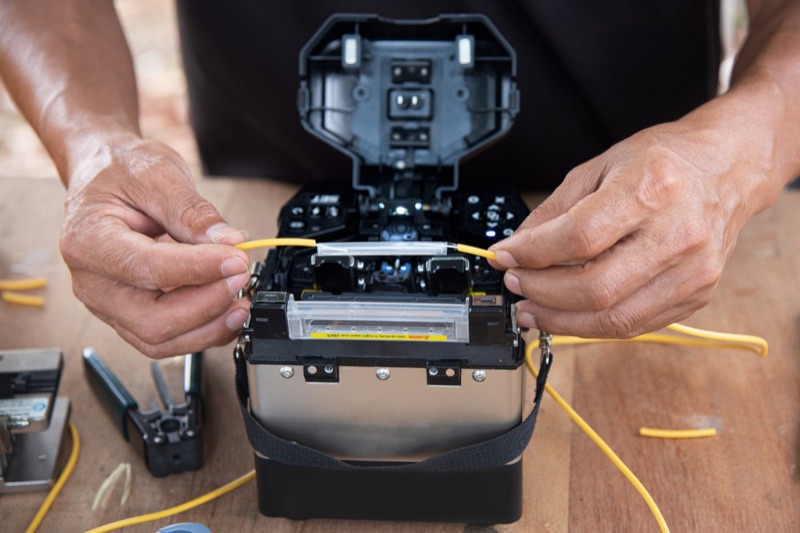
A fusion splicer joins two fiber ends by melting them together with an electric arc. Modern fusion splicers handle both single-mode and multimode fiber, but the splice parameters (arc power, arc duration, fiber alignment method) are different for each type. The splicer must be set to the correct fiber profile before making a splice. Splicing single-mode fiber with multimode parameters (or the reverse) results in a high-loss splice that may pass initially but degrades over time. For FTTH splicing applications, see our fusion splicer buying guide.
Connector Color Coding and Testing
When you arrive at a job site and find fiber patch cords in a cabinet, the jacket color tells you what you are working with before you connect a single instrument. Yellow jacket means single-mode. Orange means OM1 or OM2 multimode. Aqua means OM3. Violet means OM4. Lime green means OM5. This color coding is defined by TIA-598 and is universal across manufacturers. For more on connector identification, see our guide to SC/APC vs UPC connectors.
The Real Cost Comparison
The cost question is more nuanced than "multimode is cheaper." It depends on what you are counting.
Cable Cost: Essentially Equal
The per-meter cost of single-mode and multimode fiber cable is very close. In some cases, single-mode cable is actually cheaper because it is manufactured in higher volume (the global installed base of single-mode far exceeds multimode due to telecom deployments). The cable cost is rarely the deciding factor.
Transceiver Cost: Multimode Is Cheaper (For Now)
The traditional cost advantage of multimode is in the transceivers. 850nm VCSELs are simpler and cheaper to manufacture than the DFB (distributed feedback) lasers used in single-mode transceivers. For 10GbE, a multimode SFP+ can be 30-50% cheaper than a single-mode SFP+. However, this gap has been closing steadily. Silicon photonics technology is reducing single-mode transceiver costs, and at 100GbE and above, the per-gigabit cost difference between single-mode and multimode transceivers is shrinking to the point where it may not justify locking into multimode.
Installation Cost: Same
Pulling single-mode cable through conduit costs the same as pulling multimode. The cable has the same outer diameter, the same weight, and the same handling requirements. Termination and splicing require the same labor (though the splicer settings differ). There is no installation cost advantage to either fiber type.
Lifetime Cost: Single-Mode Usually Wins
Over a 15-20 year infrastructure lifecycle, single-mode typically has lower total cost of ownership. The reason is upgrade headroom. When you need to go from 10GbE to 25GbE to 100GbE, single-mode fiber supports the upgrade with just a transceiver swap. Multimode may require a cable replacement if the existing OM grade cannot support the new speed at the required distance. A cable replacement is far more expensive than the transceiver savings accumulated over the previous years.
Making the Decision: A Practical Framework
If you are standing in front of a cable tray deciding what to pull, here is a straightforward decision process:
- Is any run over 300 meters? Single-mode. No multimode grade supports high-speed Ethernet reliably beyond this distance.
- Is this an outside plant or FTTH deployment? Single-mode. Always. No exceptions.
- Is this inside a single data center where all runs are under 100 meters? Multimode OM3 or OM4 is a reasonable choice if transceiver cost savings matter at scale.
- Is this a new building backbone or campus link? Single-mode for future-proofing, unless budget constraints are severe and runs are short.
- Do you already have OM3/OM4 installed? Continue using it if it meets your distance and speed requirements. Do not replace working infrastructure without a reason.
- Are you installing fiber for the first time with no legacy plant? Single-mode. The cable cost is the same, and the upgrade path is significantly better.
Frequently Asked Questions
What is the difference between single-mode and multimode fiber?
The fundamental difference is the core diameter. Single-mode fiber has a 9-micrometer core that carries light in one path (one mode). Multimode fiber has a 50-micrometer or 62.5-micrometer core that carries light in hundreds of simultaneous paths (modes). This core size difference determines everything else: single-mode supports distances up to 80 kilometers or more, while multimode is limited to 100-550 meters depending on the speed and OM grade. Single-mode uses 1310nm and 1550nm laser wavelengths; multimode typically uses 850nm VCSELs.
Which is better, single-mode or multimode fiber?
Neither is universally better -- each serves different applications. Single-mode is better for long distances (over 300 meters), higher bandwidth, future-proofing, and any outside plant or campus backbone application. Multimode is better for short-distance data center interconnects (under 300 meters) where the lower cost of VCSEL-based transceivers matters and the existing infrastructure is already multimode. For new installations where you are pulling cable for the first time, single-mode is almost always the better long-term investment.
Can I use single-mode transceivers with multimode fiber or vice versa?
No. Single-mode transceivers use laser wavelengths (1310nm, 1550nm) and launch optics designed for a 9-micrometer core. Plugging a single-mode transceiver into multimode fiber may produce a link, but the light will overfill the small launch area and modal dispersion will cause high bit error rates and unreliable performance. Multimode transceivers (850nm VCSELs) plugged into single-mode fiber will have extreme insertion loss because the VCSEL launch spot is much larger than the 9-micrometer core. Always match the transceiver type to the fiber type.
What do OM1, OM2, OM3, OM4, and OM5 mean?
OM stands for Optical Multimode, and the number indicates the performance grade. OM1 (62.5/125, orange jacket) supports 10Gb Ethernet to 33 meters. OM2 (50/125, orange jacket) supports 10Gb to 82 meters. OM3 (50/125, aqua jacket) supports 10Gb to 300 meters and 40/100Gb to 100 meters. OM4 (50/125, violet jacket) supports 10Gb to 400 meters and 40/100Gb to 150 meters. OM5 (50/125, lime green jacket) adds support for short-wavelength division multiplexing at 850-953nm for higher bandwidth. OM3 and OM4 are the current standards for new data center multimode installations.
Why is FTTH almost always single-mode fiber?
FTTH uses single-mode fiber for three reasons. First, the distances involved -- from the central office or cabinet to the home -- routinely exceed 300 meters and can reach 20 kilometers or more, which is far beyond multimode's capability. Second, FTTH uses PON technology with optical splitters, and each split adds loss that only single-mode's superior link budget can accommodate. Third, the cost of single-mode fiber cable itself is comparable to multimode, and since FTTH uses a single fiber per subscriber with wavelength-division multiplexing, the bandwidth capacity of single-mode is essential. The fiber installed today needs to support speed upgrades for decades.
Related Reading
- Best Fusion Splicers for FTTH -- comparison of splicers that handle both single-mode and multimode fiber.
- SC/APC vs SC/UPC Connectors -- understanding the connector polish types used in single-mode FTTH installations.
- GPON vs XGS-PON Power Meters -- testing single-mode PON networks at the correct wavelengths.
Shop Fiber Optic Test Equipment and Cable
Power meters, OTDRs, fusion splicers, and patch cords for single-mode and multimode fiber installations.