Events and Loss: What Each Term Actually Means
The OTDR trace contains two fundamentally different kinds of information: discrete events and continuous loss along the fiber. Understanding which is which is the foundation for reading the trace correctly.
Event
An event is a discrete deviation from the smooth backscatter slope. It is a thing -- a connector, splice, bend, break -- located at a specific point on the fiber. Each event has properties: location (distance from the OTDR), type (reflective or non-reflective), and depending on the event type, associated loss and reflectance values.
Loss
Loss is a measured value in dB describing optical power reduction. There are several different losses on an OTDR trace:
- Event loss -- loss attributable to a single discrete event.
- Section loss -- loss across a length of fiber between two events, attributable to the fiber itself.
- Cumulative loss -- total loss from the start of the trace to a given point.
- Total link loss -- end-to-end loss from the first to the last link connector.
- Reflectance -- ratio of reflected to incident power at a reflective event (technically not a loss but reported in dB).
For background on the trace structure, see OTDR trace interpretation.
Event Detection vs Event Loss
Event detection is the OTDR's identification of discrete events on the trace. Event loss is the loss value the OTDR calculates for each detected event. The two are related but separate operations.
How the OTDR Detects Events
The OTDR analyzes the trace looking for deviations from the expected smooth backscatter slope. A reflective event is detected by a sudden upward spike. A non-reflective event is detected by a step change in slope or level that exceeds a threshold (typically 0.05 dB). The detection threshold determines how small an event must be before the OTDR ignores it as noise.
How the OTDR Calculates Event Loss
Once an event is detected, the OTDR calculates its loss by comparing backscatter levels before and after the event. The OTDR fits linear regressions to the backscatter slope on each side, then measures the level difference at the event point. This is the event loss.
Event loss accuracy depends on the trace having clean linear backscatter slopes both before and after the event. Events too close together (closer than the OTDR's event dead zone at the chosen pulse width) cannot be measured accurately because there is no clean fiber between them for the regression fit. See OTDR dead zones for the dead zone limits.
Types of Loss on an OTDR Trace
| Loss Type | What It Measures | Typical Values | Used For |
|---|---|---|---|
| Connector loss | Per-connector event loss | 0.2 to 0.5 dB | Connector quality verification |
| Fusion splice loss | Per-splice event loss | 0.02 to 0.05 dB | Splice quality acceptance |
| Mechanical splice loss | Per-splice event loss | 0.1 to 0.5 dB | Splice acceptance |
| Macrobend loss | Bend-induced event loss | 0.1 to 5 dB | Bend identification |
| Section loss (fiber) | Loss per kilometer of fiber | 0.35 dB/km @ 1310, 0.22 @ 1550 | Fiber attenuation verification |
| Cumulative loss | Total loss to a given distance | Sum of events + sections | Loss budget tracking |
| Total link loss | End-to-end link loss | Engineered budget value | Link acceptance certification |
| Reflectance | Reflected power ratio | -45 to -65 dB typical | PON system safety |
| Optical Return Loss (ORL) | Total reflection back to OTDR | -30 to -50 dB | System-level reflection |
Section Loss: Loss Without an Event
Section loss is the loss across a length of fiber that has no discrete events -- just smooth backscatter slope. It is calculated as the level difference between two endpoints divided by the distance between them. The result is loss per kilometer (dB/km), the fiber's attenuation coefficient.
What Section Loss Tells You
Section loss should match the fiber's specified attenuation. Standard single-mode at 1310nm is approximately 0.35 dB/km. At 1550nm, 0.22 dB/km. Multimode is much higher: ~3 dB/km at 850nm, ~1 dB/km at 1300nm.
Elevated section loss with no visible discrete events indicates fiber damage, stress, contamination, or a different fiber type than specified. The trace shows a steeper-than-expected slope across a region rather than a sharp event.
Distributed vs Localized Loss
Distributed loss (elevated dB/km across a long section) is different from localized loss (a discrete event). Distributed loss has many possible causes including hydrogen contamination of buried fiber, elevated temperature, or chronic stress. Localized loss is almost always a connector, splice, or macrobend.
Why Bidirectional Loss Measurements Matter
Loss measured from one direction can be inaccurate at fusion splices because of the gainer artifact. The OTDR estimates loss from backscatter, and when two fibers with different backscatter coefficients are spliced, the apparent loss is biased. The bias goes one direction from end A and the opposite direction from end B.
Bidirectional testing measures the link from both ends and averages the per-event loss values. The result is the true loss at each event, with the gainer artifact canceled out. This is required for accurate splice loss documentation on any acceptance test that depends on per-splice loss values.
The math: true_loss = (loss_AtoB + loss_BtoA) / 2
OTDR Loss vs Power Meter Loss
Both instruments report total link loss. The values usually agree within 0.2-0.5 dB but they do not always agree exactly, and when they disagree the power meter is typically the reference of record.
Why They Disagree
The OTDR estimates loss from backscatter analysis. Backscatter levels can be biased by gainer artifacts (canceled by bidirectional averaging), dead zone effects (eliminated by launch and receive cables), and noise floor variation (worse at long distances and short pulse widths). Even with all these mitigations, the OTDR loss number has ~+/- 0.1-0.3 dB residual uncertainty.
The power meter measures absolute optical power directly. Connect a calibrated source to one end and a calibrated meter to the other and the loss is just source_power - received_power. Calibration accuracy is typically +/- 0.05 dB, much better than the OTDR.
Which to Use for Certification
For carrier acceptance, the power meter measurement is the certification value of record. The OTDR documents per-event detail; the power meter certifies the total loss budget. We cover this in detail in OTDR vs power meter.
Practical Use: What to Look at on the Trace
When walking a trace for acceptance testing, look at each loss value in this order:
- Total link loss -- the headline number. Compare against engineered budget. If over budget, dig into per-event detail.
- Each event loss -- connectors should be under 0.5 dB, fusion splices under 0.1 dB. Anything outside spec is a flagged event for rework.
- Each section loss -- dB/km should match fiber spec. Steep sections indicate fiber stress or damage.
- Reflectance values -- all reflective events should be better than -40 dB. Worse than -40 dB indicates contamination, damage, or wrong connector type (UPC where APC was specified).
For the complete OTDR test workflow, see how to launch an OTDR test step by step.
Reflectance and Optical Return Loss
Reflectance is reported in dB on the OTDR but is not technically a loss. It is the ratio of optical power reflected at an event to the power incident on the event. Lower reflectance (more negative dB) is better. Reflectance is critical because high-reflectance events cause Raman scattering, FEC errors, and signal degradation in PON systems.
Per-Event Reflectance
Each reflective event on the trace has a reflectance value. UPC connectors typically show -45 to -55 dB. APC connectors show -60 dB or better. Mechanical splices show -40 to -55 dB. Carrier acceptance specs typically require all reflective events better than -40 dB.
Optical Return Loss (ORL)
ORL is the total reflected power summed across all events in the link, expressed as the ratio of reflected to incident power at the OTDR. ORL is the system-level reflection metric -- it tells you how much of the transmitted signal is bouncing back to the source rather than reaching the receiver. Most modern OTDRs calculate ORL automatically. Typical FTTH link ORL is -30 to -50 dB.
Reflectance vs Loss
An event can have low loss but high reflectance, or high loss but low reflectance. A clean APC connector might have 0.3 dB loss and -65 dB reflectance (excellent on both metrics). A contaminated UPC connector might have 0.4 dB loss but -25 dB reflectance (passing on loss, failing on reflectance). Both metrics matter and both must be in spec for the link to pass.
The Math: Adding Up Losses
For acceptance testing, the engineered loss budget for a link is the sum of all expected losses. Compare against the measured trace to verify the link is within budget.
Example FTTH Drop
A 500 meter FTTH drop with one fusion splice and a 1:32 splitter:
- Fiber attenuation: 0.5 km × 0.35 dB/km = 0.18 dB
- Connector at OLT: 0.3 dB
- Splitter (1:32): 17.0 dB
- Fusion splice: 0.05 dB
- Connector at ONT: 0.3 dB
- Aging margin: 1.0 dB
- Total budget: 18.83 dB
The measured trace should show total link loss within 0.5-1 dB of this budget. Significantly higher means a problem somewhere -- typically a contaminated connector, marginal splice, or hidden bend.
Example Backbone Link
A 60 km backbone link with 12 fusion splices and 2 connectors (one at each end):
- Fiber attenuation: 60 km × 0.22 dB/km = 13.2 dB
- 2 connectors: 2 × 0.3 dB = 0.6 dB
- 12 fusion splices: 12 × 0.05 dB = 0.6 dB
- Aging margin: 1.0 dB
- Total budget: 15.4 dB
This is well within the budget of GPON OLT-to-ONT links (typically 28 dB) or Ethernet 10G-LR transceivers (typically 6 dB at 10 km maximum, so this 60 km link would not work for 10G-LR but would for 10G-ER at 40 km maximum or longer-reach transceivers).
Test Equipment
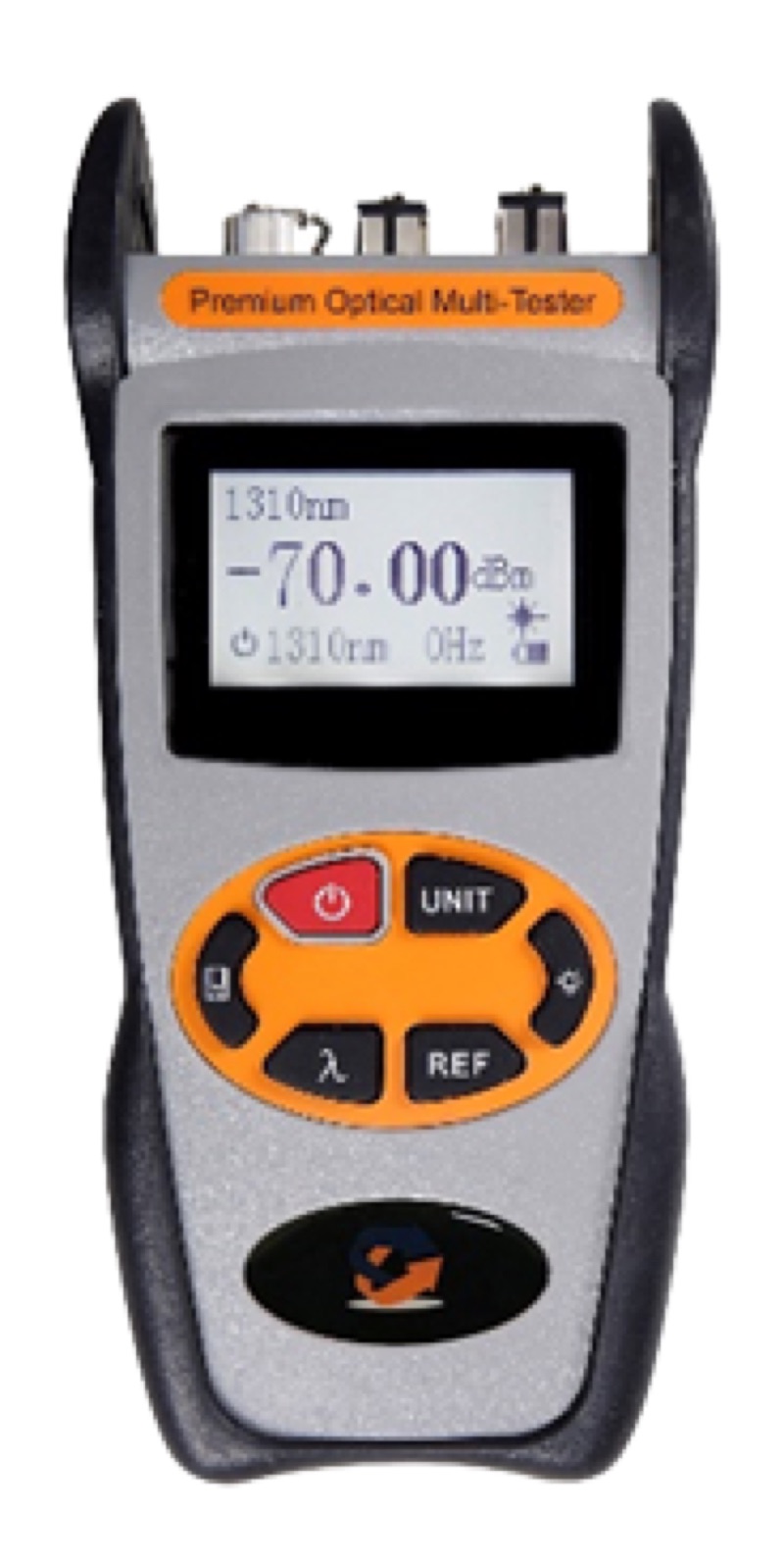
For complete event and loss characterization: the Fiber Ranger OTDR handles event detection, event loss, and section loss measurements at FTTH and metro scales. Pair with the Optical Power Meter LC for end-to-end loss certification, the WiFi Fiber Microscope for connector inspection on flagged events, and a visual fault locator for visually verifying break locations.
Event Detection Thresholds
OTDRs do not flag every fluctuation as an event. Each unit has detection thresholds that determine which features make it into the event list and which get smoothed into the backscatter slope.
Loss Threshold
Most OTDRs default to flagging events with at least 0.05 dB to 0.1 dB of loss. Below the threshold, an event is invisible to the event-list summary even though the loss still contributes to total link loss. Adjust the threshold downward if you need to detect very low-loss splices.
Reflectance Threshold
Reflective event detection typically triggers at -65 dB reflectance or stronger. Connectors at -75 dB are below the floor of most field OTDRs and may not appear as events. This rarely matters in practice because such low reflectance is below what most networks see in production.
End-of-Fiber Threshold
The OTDR identifies the end of the fiber based on a sharp drop into the noise floor, typically 5+ dB below the local backscatter level. If the fiber ends at a high-loss connector or absorber, the OTDR may not flag the end correctly. Manually mark the end position when the auto-detect misses it.
Negative-Loss Events: The Gainer Problem
An OTDR sometimes reports a splice or connector with negative loss, meaning more light came out than went in. This is physically impossible. The cause is a backscatter coefficient mismatch between the two fibers being joined.
Why Gainers Happen
OTDR loss measurement compares the backscatter level just before an event to the backscatter level just after. If the second fiber has a higher backscatter coefficient (more glass scattering), the post-event backscatter is artificially elevated, making the splice look like it added power. The actual splice loss may be 0.05 dB, but the OTDR reports -0.10 dB.
The Bidirectional Fix
If the splice looks like a gainer in one direction, it will look like an exaggerated loss in the opposite direction. Run an OTDR test in each direction, average the two values, and the gainer artifact cancels out. The averaged value is the actual splice loss.
When Single-Direction Is Acceptable
For FTTH drops where you only need to confirm the link is below a fail threshold, single-direction tests are fine. Gainer artifacts will not push a real failure into the pass column at FTTH scale. For backbone fiber acceptance with per-splice loss documentation, bidirectional is mandatory.
Events the OTDR Cannot See
Not every problem in a fiber link produces an OTDR event. Two important categories of fault hide from OTDR detection.
Non-Reflective Splices With Very Low Loss
A perfect fusion splice with 0.02 dB loss may be below the OTDR's event detection threshold, especially at long pulse widths or in noisy traces. The link still has the splice -- the OTDR just does not flag it as an event. The total link loss includes the splice loss, so the section-loss measurement still catches it. Event-only summaries miss it.
Fiber Sections With Mild Macrobends
Macrobends spread their loss over a length of fiber rather than localizing it at a single point. The OTDR may show a slight slope change, not a discrete event. The cumulative loss appears in the section-loss measurement, and a wavelength comparison (1310 vs 1550) reveals the bend, but the OTDR does not flag a single event location.
Why End-to-End Power Meter Tests Catch What OTDR Misses
Both of these failure modes still affect end-to-end loss. A power meter measures total link attenuation directly and will catch any loss the OTDR's event analysis misses. This is one reason every fiber link should be certified with both an OTDR (for fault location) and a power meter (for end-to-end loss).
Fiber Test Equipment
OTDRs, power meters, inspection scopes, and continuity testers for complete fiber link event detection and loss characterization.