Anatomy of Connector Mating Loss
When two fiber connectors mate, optical power is lost to several mechanisms simultaneously. Understanding these mechanisms helps explain why connector loss varies and why it must be budgeted with care.
- Lateral fiber misalignment: The two fiber cores must align within fractions of a micrometer for full coupling. Manufacturing tolerances on ferrule concentricity, ferrule diameter, and adapter alignment all contribute to small lateral offsets that cause loss.
- Angular misalignment: If the two ferrule endfaces are not parallel, light exits one fiber at a slightly different angle than the next fiber's acceptance angle. This produces angular loss.
- Fiber height (undercut/protrusion): If one fiber sits slightly above or below the polished ferrule surface, the fibers do not make optical contact at the cores even though the ferrule surfaces touch. This creates an air gap that adds loss.
- Surface contamination: Dust, oil, or moisture on either ferrule scatters and absorbs light. A single particle in the core area can add 0.5-2 dB or block the link entirely.
- Mode mismatch (multimode): In multimode fiber, the launched mode distribution from one fiber may not match the accepted modes of the next, particularly across mismatched core diameters or grades.
- Polish geometry mismatch: Mating UPC to APC or different dome radii produces poor surface contact.
Standard Per-Pair Loss Values
The values you should use in link budget calculations depend on the standard you are designing to and the connector type:
| Connector / Polish | Typical Measured | Maximum (Spec) | Design Budget |
|---|---|---|---|
| Factory LC/UPC | 0.10-0.20 dB | 0.30 dB | 0.50 dB |
| Factory SC/UPC | 0.15-0.25 dB | 0.30 dB | 0.50 dB |
| Factory SC/APC | 0.20-0.30 dB | 0.40 dB | 0.50 dB |
| Factory LC/APC | 0.20-0.30 dB | 0.40 dB | 0.50 dB |
| Field mechanical splice connector | 0.30-0.50 dB | 0.75 dB | 0.75 dB |
| Pre-polished field connector | 0.30-0.50 dB | 0.75 dB | 0.75 dB |
| MPO (per mated pair) | 0.30-0.50 dB | 0.75 dB | 0.75 dB |
| Multimode connector | 0.20-0.40 dB | 0.50 dB | 0.75 dB |
The "Design Budget" column is the value you should use in calculations. It builds in margin for manufacturing variance, aging, and field handling. If your actual measured loss is lower, you have margin in the link. If it is higher (due to contamination, damage, or suboptimal mating), you may still be within budget.
Splice Loss for Comparison
Splices are an alternative way to join fibers and have their own characteristic loss values:
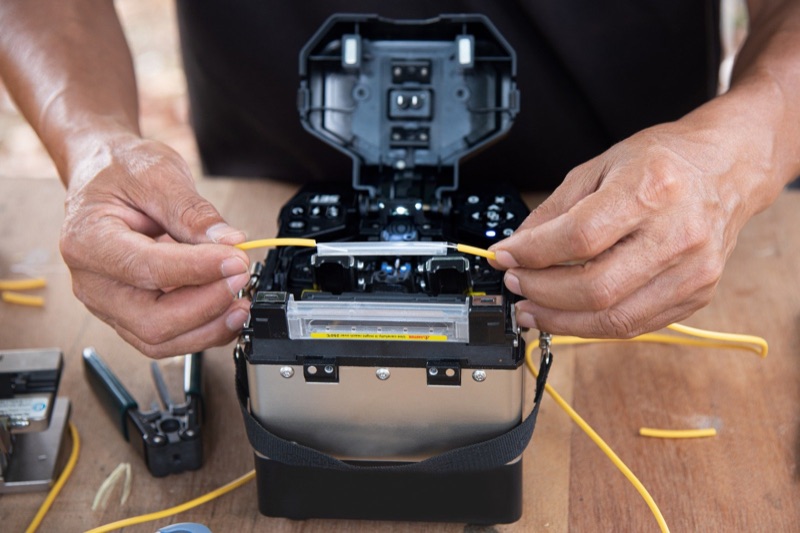
- Fusion splice: 0.05-0.10 dB typical, 0.15 dB design budget. The lowest-loss option for joining fibers.
- Mechanical splice: 0.10-0.25 dB typical, 0.30 dB design budget. Faster than fusion but higher loss.
For a comparison of fusion and mechanical splicing, see our mechanical splice vs fusion splice guide.
Cumulative Loss in Real Links
A real-world fiber link has multiple connector pairs and possibly multiple splices. The total connector loss is the sum of all per-pair losses. Consider a typical FTTH PON link from OLT to ONT:
Example: GPON Link Loss Budget
- OLT line card to central office patch panel: 1 connector pair, 0.5 dB
- Patch panel to feeder cable: 1 connector pair (or fusion splice), 0.5 dB or 0.15 dB
- Feeder cable through 1:32 splitter: splitter insertion loss approximately 17 dB
- Splitter output to distribution cable: 1 connector pair or splice, 0.5 dB or 0.15 dB
- Distribution to drop cable: 1 connector pair, 0.5 dB
- Drop cable to ONT: 1 connector pair, 0.5 dB
- Fiber attenuation: approximately 0.2 dB/km at 1490nm, 5 km link = 1.0 dB
Total estimated loss: 17.0 (splitter) + 2.5 (4 connector pairs) + 1.0 (fiber) + 0.5-1.5 (additional splices/connectors) = approximately 21-22 dB.
GPON Class B+ has a 28 dB downstream loss budget. This link operates with about 6-7 dB of margin, which is typical and healthy. If you added two more connector pairs (e.g., extra patch panels in the path), you would consume an additional 1 dB of budget, leaving 5-6 dB margin -- still acceptable but starting to constrain future flexibility.
Example: 10GBASE-LR Data Center Link
10GBASE-LR is a 10Gb single-mode standard with a 6.0 dB loss budget over 10 km of fiber. Consider a 1 km cross-building link:
| Element | Loss |
|---|---|
| Transceiver patch cord at building A switch | 0.5 dB |
| Building A patch panel cross-connect | 0.5 dB |
| Outside plant fiber, 1.0 km at 0.4 dB/km | 0.4 dB |
| 2 fusion splices (entry and exit of OSP) | 0.3 dB |
| Building B patch panel cross-connect | 0.5 dB |
| Transceiver patch cord at building B switch | 0.5 dB |
| Total link loss | 2.7 dB |
| 10GBASE-LR budget | 6.0 dB |
| Margin | 3.3 dB |
This link has comfortable margin. If your actual measured loss is higher (3.5-4.0 dB) and you have not changed the design, the most likely cause is contamination on one or more connectors. Cleaning all four connector pairs and re-measuring should bring the loss back to the calculated value.
How Much Margin to Reserve
Designing a link to exactly the maximum spec value is a recipe for failure. Reserve margin for:
- Aging: Connector ferrules degrade over thousands of mating cycles. Cable attenuation increases slightly with temperature cycling and microbending over decades. Budget 0.5-1.0 dB for 20+ year aging.
- Contamination drift: Even with regular cleaning, average contamination level rises slightly over time. Budget 0.5 dB for ongoing contamination buildup.
- Future patch panel additions: If the link will pass through additional patch panels added during its lifetime, pre-budget those connector pairs. Each future panel = 0.5 dB.
- Bend loss: Cable bends introduce additional loss, particularly at 1550nm. Budget 0.2-0.5 dB for bend loss in cables routed through congested pathways.
- Repair splices: Cables get cut and repaired during their lifetime. Each repair adds a fusion splice (0.15 dB design budget). Reserve 0.5 dB for two future repair splices.
Total recommended margin: 2-3 dB for typical installations, 3-5 dB for critical or long-life applications. If your design has less than 1 dB margin, you are riding the edge of failure.
Measuring Real-World Connector Loss
Predicted budget is the design tool; measurement is the validation. Two test methods reveal connector loss:
Power Meter and Light Source (Insertion Loss Test)
An optical power meter and matching light source establish a reference power level on a clean test patch cord, then measure the power through the link under test. The difference is the total link loss. Compare to your predicted budget to identify whether the link is meeting design.
OTDR (Per-Event Loss)
An OTDR identifies each connector and splice as a discrete event on the trace. The OTDR reports the loss at each event, allowing you to identify which specific connector or splice is contributing excessive loss. If one connector pair shows 1.5 dB on the OTDR while others show 0.3 dB, that connector needs cleaning or replacement.
For OTDR fundamentals, see our OTDR basics guide.
Reducing Connector Loss in the Field
If a measured link is over budget and you suspect connector contamination:
- Inspect every connector with a fiber microscope before disturbing anything. Document what you find.
- Clean each connector with a one-click cleaner -- CLeP-125 for LC and other 1.25mm ferrules, CLeP-25 for SC, FC, and other 2.5mm ferrules.
- Re-inspect to confirm cleanliness.
- Re-mate and re-measure.
- If still over budget, replace any connector that is damaged or aged.
For the full cleaning workflow, see our guides on how to clean fiber connectors and fiber endface cleaning.
Frequently Asked Questions
How much loss does a fiber connector add?
Each fiber connector mating pair adds typically 0.10 to 0.50 dB of insertion loss, with 0.30-0.75 dB used as the design budget value in most TIA and ISO link budget calculations. Factory-terminated patch cords with high-quality polish achieve 0.10-0.20 dB. Field-terminated mechanical splice connectors typically reach 0.30-0.50 dB. Contaminated or damaged connectors can show 1 dB or more, which usually fails the link.
How many connectors can I have in a fiber link?
The number depends on the link budget margin. A typical 10GBASE-LR link has approximately 6.0 dB of total loss budget. With 0.5 km of single-mode fiber at 0.4 dB/km, two patch cord pairs at 0.5 dB each, and 1 dB of margin, you have 3.8 dB remaining for additional connectors and splices. At 0.5 dB per mating pair, that allows roughly 7 additional pairs. Always design with margin -- aging, contamination, and bend loss consume budget over time.
Is connector mating loss the same as insertion loss?
Mating loss and insertion loss are often used synonymously, but technically mating loss specifically refers to the loss across one mated pair of connectors (two connectors mating in an adapter), while insertion loss can refer to either a single connector or an entire link. In link budget calculations, the relevant value is the mating loss per pair, which is what manufacturers specify on patch cord datasheets.
Should I use typical or maximum connector loss in my link budget?
Use the maximum (or design budget) value, not the typical. Typical values describe the median performance of new, clean connectors in a controlled environment. Real installations have manufacturing variation, contamination, aging, and handling damage. Designing to the typical value means roughly half your links will fail to meet budget -- catastrophic for a deployment of any size. Designing to the maximum value gives you margin and confidence.
Related Reading
- OTDR Basics -- the test instrument that measures per-event loss in real links.
- Mechanical Splice vs Fusion Splice -- the loss tradeoffs between splice types.
- How to Clean Fiber Connectors -- the most common way to reduce connector loss in real links.
Test Equipment for Link Budget Verification
Optical power meters, OTDRs, and inspection scopes for measuring real-world connector and link loss in single-mode and multimode systems.