The Quick Answer
How Mechanical Splicing Works
A mechanical splice joins two fiber ends without heat or electricity. The fibers are stripped, cleaned, cleaved to a flat endface, and then inserted into a precision alignment sleeve from opposite ends. The sleeve physically aligns the fiber claddings (and by extension, the cores) using a V-groove or cylindrical bore. Index-matching gel fills the tiny air gap between the fiber endfaces, reducing Fresnel reflection and providing an optical pathway across the joint.
The alignment sleeve holds the fibers in place through mechanical clamping. Some designs use a cam mechanism that locks with a quarter-turn; others use a snap-closure housing. The entire assembly is then enclosed in a protective housing that provides strain relief and environmental protection.
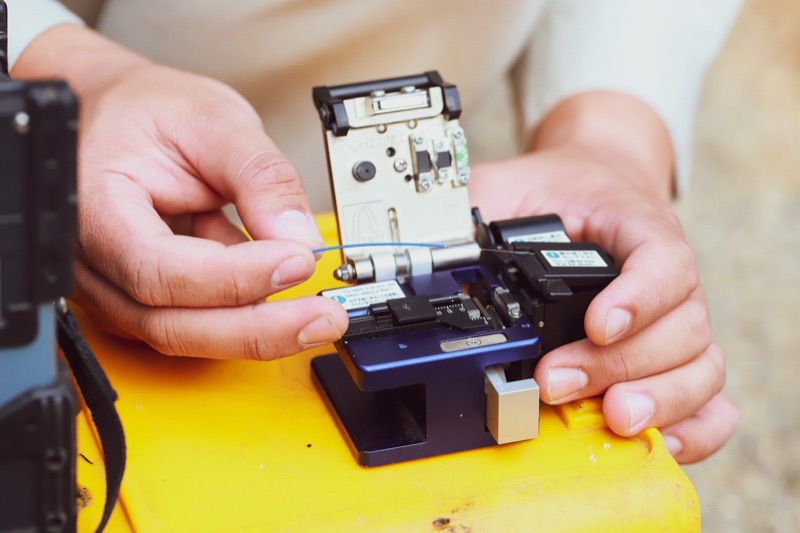
The process takes about 2-5 minutes per splice once you have practice, and the only tools required are a fiber stripper, cleaning supplies, and a precision cleaver. No electricity is needed, which makes mechanical splicing viable in environments where a fusion splicer cannot operate -- inside a confined space, during a power outage, or when you simply do not have a splicer in the truck.
Mechanical Splice Performance
Typical insertion loss for a well-made mechanical splice on single-mode fiber is 0.1-0.5 dB, with most falling in the 0.2-0.3 dB range. Return loss is typically 40-55 dB. The variation comes primarily from cleave quality and fiber alignment -- because the sleeve aligns the cladding rather than the core, any core-to-cladding concentricity error in the fiber directly contributes to splice loss.
The index-matching gel is a critical component. It eliminates the air gap between fiber endfaces that would otherwise cause approximately 0.3 dB of Fresnel reflection per interface (0.6 dB total for two endfaces). Without the gel, a mechanical splice would have unacceptably high reflection and loss. However, the gel can degrade over time -- it may dry out, absorb moisture, or shift with thermal expansion and contraction. This is the primary long-term reliability concern with mechanical splices.
How Fusion Splicing Works
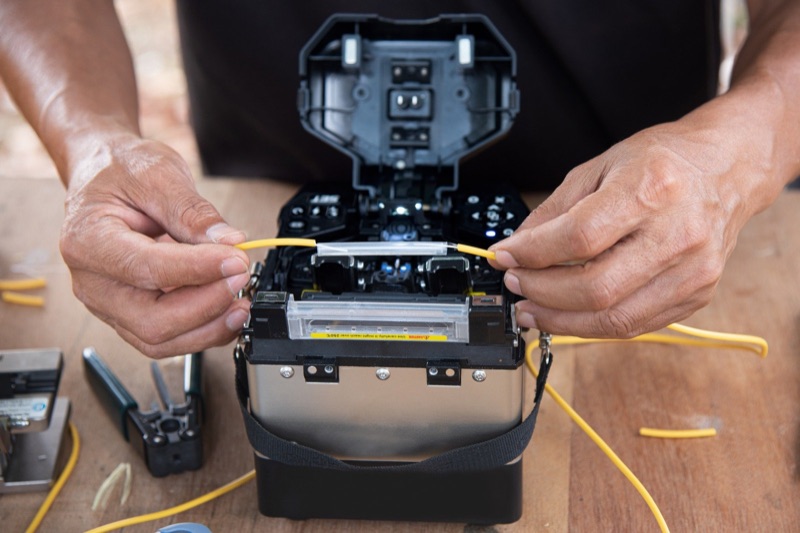
Fusion splicing permanently joins two optical fibers by melting their glass endfaces together with a precisely controlled electric arc. The result is a continuous glass path with no air gap, no gel, no mechanical interface -- just a single strand of glass from end to end.
The process begins the same way as a mechanical splice: strip the fiber coating, clean the bare glass, and cleave it to produce a flat endface. The cleaved fibers are placed in V-groove holders on the splicer, which uses cameras and image processing to view the fiber cores from two orthogonal angles. A core-alignment splicer actively positions the fibers until the cores are precisely aligned -- compensating for any cladding-to-core concentricity errors in the fiber.
Once aligned, the splicer fires a brief electric arc (typically 7-10 seconds) that heats both fiber tips to approximately 2,000 degrees Celsius -- above the softening point of silica glass. The molten glass from both fibers flows together and fuses into a single strand. The splicer estimates the splice loss based on the core alignment before and after the arc, displaying the result on screen. The complete splice cycle from fiber placement to loss estimate takes 8-12 seconds.
After the arc, the bare splice point is protected with a heat-shrink splice protection sleeve -- a small tube with a steel strength member and hot-melt adhesive that seals the splice from moisture and provides mechanical reinforcement. The sleeve is heated in the splicer's built-in oven (or an external heater) and shrinks to form a permanent, rigid protective jacket around the splice point.
Fusion Splice Performance
Modern core-alignment fusion splicers achieve typical splice losses of 0.02-0.05 dB on single-mode fiber. Return loss exceeds 60 dB because there is no interface -- the glass is continuous. The industry acceptance threshold for a fusion splice is 0.1 dB; anything above that should be cut out and re-spliced.
Because the splicer actively aligns the fiber cores rather than relying on cladding alignment, fusion splices are consistently low-loss regardless of fiber concentricity variations between manufacturers or fiber batches. This is a significant advantage on long-haul routes or high-split-ratio PON networks where every hundredth of a dB matters in the link budget.
The fusion bond is permanent. It is a continuous glass structure that is unaffected by temperature cycling, vibration, humidity, or time. A fusion splice made in 2006 will measure the same loss in 2046. There is nothing to dry out, shift, or degrade.
Head-to-Head Comparison
Here is every specification that matters when choosing between mechanical and fusion splicing, in one table.
| Specification | Mechanical Splice | Fusion Splice |
|---|---|---|
| Typical insertion loss | 0.1 - 0.5 dB | 0.02 - 0.05 dB |
| Return loss | 40 - 55 dB | > 60 dB |
| Reliability | Good (indoor); fair (outdoor) | Excellent (all environments) |
| Time per splice | 2 - 5 minutes | 30 - 60 seconds (total cycle) |
| Cost per splice (consumables) | $3 - $8 per connector | < $1 (splice sleeve only) |
| Equipment cost | < $500 (cleaver + connectors) | $2,000 - $3,000+ (splicer + cleaver) |
| Skill required | Low to moderate | Moderate (training recommended) |
| Power required | None | Battery or AC (built-in battery) |
| Weather sensitivity | Gel affected by extreme temp | Temperature-immune once spliced |
| Permanence | Semi-permanent (removable) | Permanent (must cut to redo) |
| Re-workable | Yes -- can open and re-align | No -- must cleave and re-splice |
| Fiber alignment method | Passive cladding alignment | Active core alignment |
When to Use Mechanical Splicing
Mechanical splicing has clear advantages in specific scenarios. It is not an inferior technology -- it is a different tool for different situations.
Emergency Fiber Restoration
When a fiber cable is cut and service is down, the priority is restoring connectivity as fast as possible. A mechanical splice gets light through the fiber in minutes without waiting for a fusion splicer to arrive. Many fiber restoration crews carry mechanical splice kits specifically for emergency temporary repairs. The splice can be replaced with a fusion splice during a planned maintenance window later.
Temporary Connections
Construction sites, event venues, temporary office setups, and disaster response operations all need fiber connections that will be removed within days or weeks. Mechanical splicing provides a solid connection without investing time and equipment in a permanent fusion splice that will be cut out anyway.
Low Fiber Count, Budget-Constrained Jobs
If you are splicing fewer than 500 fibers per year and do not own a fusion splicer, the economics of mechanical splicing make sense. A Mechanical Cleaver ($299.99) and a box of mechanical connectors get you working for under $500. The per-splice consumable cost is higher, but the capital investment is dramatically lower.
No-Power Environments
Mechanical splicing requires zero electricity. If you are working in an underground vault with no power, a confined space where you cannot bring a splicer, or a remote location without battery charge, mechanical splicing is your only option. The entire operation can be performed with hand tools and natural light (though a headlamp helps).
Training and Education
Mechanical splicing is an excellent teaching tool for new fiber technicians. It teaches the fundamentals of fiber preparation -- stripping, cleaning, cleaving -- without the complexity of operating a fusion splicer. Many training programs start students on mechanical splicing before advancing to fusion.
When to Use Fusion Splicing
For the majority of professional fiber installations, fusion splicing is the standard. Here is where it is non-negotiable.
FTTH Permanent Installations
Every FTTH drop, distribution splice, and backbone splice in a permanent fiber network should be fusion spliced. The splice will be inside a closure or enclosure for 20+ years. Link budgets on PON networks are tight -- a 1x32 splitter already introduces 17-18 dB of loss, and every additional tenth of a dB from splices eats into your margin. Fusion splicing at 0.02-0.05 dB per splice gives you maximum headroom.
Data Center and Central Office
Data centers demand the lowest possible loss and highest return loss. Fusion splicing is the only method that consistently achieves both. The controlled indoor environment means you can set up a proper splicing workstation with the Fusion Splicer ($2,349.99).
Backbone and Long-Haul
On long-haul routes, splice loss is cumulative. A 100 km route with splices every 4 km has 25 splice points. At 0.3 dB per mechanical splice, that is 7.5 dB of splice loss alone. At 0.04 dB per fusion splice, it is 1.0 dB. The 6.5 dB difference can mean the difference between needing an optical amplifier or not -- and amplifiers cost far more than a fusion splicer.
Any Project Where Link Budget Matters
If you are calculating a link budget, you want the lowest splice loss you can achieve. This includes high-split-ratio PON deployments (1x32 or 1x64), WDM systems, DWDM networks, and any installation where the optical power margin is tight. Fusion splicing is not optional in these scenarios -- it is a design requirement.
Outdoor Plant and Aerial
Aerial splice closures and underground vaults experience wide temperature swings, vibration from wind or traffic, and moisture exposure. Mechanical splice gel can shift or degrade in these conditions, causing intermittent loss increases that are difficult to diagnose. Fusion splices are immune to all of these environmental factors because the glass bond is permanent and continuous.
Cost Analysis: When Does Fusion Pay for Itself?
The question is not which method is better -- fusion wins on every performance metric. The question is whether the capital investment in a fusion splicer is justified for your splice volume.
The Math
A practical cost comparison between the two approaches:
- Fusion splicer investment: splicer plus precision cleaver, roughly $2,650 at today's prices
- Fusion consumable cost: Splice protection sleeves run approximately $0.50-$0.75 each
- Mechanical splice cost: $3-$8 per mechanical connector, plus cleaver ($299.99 one-time)
Assuming a mechanical connector cost of $5 per splice and a fusion consumable cost of $0.65 per splice, the net savings per splice with fusion is $4.35. Dividing the splicer investment of $2,349.99 by $4.35 gives a breakeven point of approximately 540 splices.
For context, a single FTTH splice closure with 24 fibers requires 24 splices. A tech doing 4-5 closures per week hits 540 splices in roughly 3-4 weeks. For most professional fiber contractors, the fusion splicer pays for itself within the first month of regular use.
The Hidden Cost of Mechanical Splices
The per-splice consumable cost is the obvious comparison, but mechanical splices carry hidden costs that do not show up in the initial calculation:
- Truck rolls for re-work: Mechanical splices that degrade over time from temperature cycling cause intermittent issues that require troubleshooting visits. Each truck roll costs $150-$300 in labor and vehicle expenses.
- Higher OTDR testing time: Mechanical splices show up as distinct reflective events on an OTDR trace (due to lower return loss), requiring additional analysis time during acceptance testing.
- Link budget penalties: Budgeting 0.3 dB per splice instead of 0.05 dB may force you into more expensive optical components (lower-split-ratio splitters, higher-power OLTs) to meet power budget.
- Customer experience: Higher splice loss means less margin for aging, connector contamination, and macro-bending. Over a 20-year plant life, mechanical splice degradation can push marginal links below threshold, causing service issues.
Hot Fusion Connectors: The Middle Ground
If you already own a fusion splicer, there is a third option that combines the best of both worlds: hot fusion connectors, also called splice-on connectors (SOCs).
SC/APC Hot Fusion Connectors ($16.99 per 10-pack, $1.70 each) are factory-polished SC/APC connectors with a short fiber stub pre-loaded inside. You strip and cleave your field fiber, then fusion splice it to the factory stub inside the connector. The result is a connectorized termination with fusion-quality performance -- no field polishing, no index-matching gel, no mechanical alignment uncertainty.
Hot Fusion vs Mechanical Connector Performance
| Metric | Mechanical Connector | Hot Fusion Connector |
|---|---|---|
| Insertion loss | 0.3 - 0.5 dB | 0.15 - 0.3 dB |
| Return loss | 40 - 50 dB | > 55 dB |
| Temperature stability | Gel can shift | Fusion bond, permanent |
| Cost per termination | $3 - $8 | $1.70 |
| Equipment required | Cleaver only | Fusion splicer + cleaver |
| Time per termination | 3 - 5 minutes | 2 - 3 minutes |
Hot fusion connectors are rapidly replacing mechanical connectors in professional FTTH work. The combination of lower cost per termination, better optical performance, and long-term reliability makes them the logical choice for any technician who already owns a fusion splicer. The Mechanical Cleaver ($299.99) is required for proper fiber preparation regardless of whether you use hot fusion or mechanical connectors.
Practical Recommendations by Scenario
You Are Starting an FTTH Contracting Business
Buy a fusion splicer. The Palm Fusion Splicer at $2,349.99 is QBL's palm-size model for FTTH drops and building work. Add SC/APC Hot Fusion Connectors for field terminations. Read our Fusion Splicer Buying Guide for how to choose.
You Are a Facility Maintenance Tech Who Splices Occasionally
If you splice fewer than 50 fibers per year, the economics shift. Mechanical splice kits are a practical choice for occasional repairs and terminations. Keep a box of mechanical connectors and a cleaver in your tool kit for when you need them. But if your splice volume grows, re-evaluate -- the crossover point comes faster than most people expect.
You Need Emergency Restoration Capability
Keep mechanical splice kits in every service truck as emergency backup. Even if your primary tool is a fusion splicer, the splicer might be in another truck, out of battery, or back at the shop when a fiber cut takes down service. Mechanical splice kits take up minimal space, need no power, and get service restored in minutes while you schedule a permanent fusion splice repair.
You Are Choosing Between a Cheap Splicer and Mechanical Splicing
Do not buy a cheap cladding-alignment splicer thinking you are getting fusion quality at a lower price. Cladding-alignment splicers skip the core alignment step and produce inconsistent splice losses (often 0.05-0.2 dB) because they cannot compensate for core concentricity errors. If your budget does not reach a core-alignment splicer, mechanical splicing with a good cleaver will produce more predictable results than a cheap splicer. When the budget allows, step up to a proper core-alignment machine. See our Best Fusion Splicers for FTTH comparison for specific recommendations.
Common Mistakes with Both Methods
Regardless of which splice method you use, the preparation steps are identical and the most common source of bad splices.
Bad Cleaves
Both mechanical and fusion splices require a flat, perpendicular fiber endface. A cleave angle greater than 1-2 degrees significantly increases splice loss. A quality precision cleaver is non-negotiable for either method. Dull blades, incorrect tension settings, and dirty cleaver jaws all contribute to bad cleave angles. Replace cleaver blades on schedule -- a worn blade is the most common cause of high splice loss that technicians overlook.
Contaminated Fiber
Fiber stripping residue, coating particles, and airborne dust on the bare glass endface cause air gaps and scatter that increase splice loss. Clean every fiber with lint-free wipes and isopropyl alcohol after stripping and before cleaving. Do not touch the bare glass with your fingers -- skin oils leave a residue that degrades the splice.
Skipping the Strip-Clean-Cleave Sequence
The sequence is: strip the coating, clean the bare glass, then cleave. Every time. Cleaving through residue or contamination embeds particles in the endface and produces a poor result. Rushing this preparation to save 30 seconds costs you minutes in re-work and degrades the splice.
Frequently Asked Questions
What is the main difference between a mechanical splice and a fusion splice?
A mechanical splice uses a precision alignment sleeve and index-matching gel to hold two fiber ends together. A fusion splice uses an electric arc to permanently melt the glass cores into a single continuous strand. Fusion produces lower loss (0.02-0.05 dB vs 0.1-0.5 dB) and is permanent, while mechanical is faster to set up and requires no expensive equipment.
How much does a fusion splicer cost compared to mechanical splice equipment?
A core-alignment fusion splicer costs $2,000-$3,000 plus a precision cleaver at approximately $300. Mechanical splicing startup costs are under $500 total. However, each mechanical splice costs $3-$8 in consumables versus under $1 for a fusion splice protection sleeve. The fusion splicer investment breaks even at approximately 540 splices, which most professionals reach within their first month.
Can a mechanical splice be used permanently?
Mechanical splices can serve in permanent installations, but they are less reliable long-term than fusion splices. The index-matching gel can dry out or shift with temperature cycling, gradually increasing insertion loss over years. In stable indoor environments they can last decades. In outdoor plant with wide temperature swings, fusion splicing is the better choice for permanent connections.
What splice loss should I expect from each method?
Fusion splices: 0.02-0.05 dB insertion loss, return loss better than 60 dB. Mechanical splices: 0.1-0.5 dB insertion loss, return loss of 40-55 dB. The industry acceptance threshold for fusion is 0.1 dB. For mechanical, anything under 0.3 dB is a good result.
Are hot fusion connectors better than mechanical connectors?
Yes, if you own a fusion splicer. SC/APC Hot Fusion Connectors achieve 0.15-0.3 dB insertion loss compared to 0.3-0.5 dB for mechanical connectors, and the fusion bond is permanent and temperature-immune. At $1.70 per connector, they also cost less per termination than most mechanical connectors.
Ready to Upgrade Your Splicing?
Whether you are making the jump from mechanical to fusion or building out a complete fiber termination kit, these are the QBL and Platinum Tools items we list.
- Palm Fusion Splicer ($2,349.99) -- QBL's palm-size fusion splicer
- Fusion Splicer ($2,349.99) -- QBL's standard fusion splicer
- SC/APC Hot Fusion Connectors ($16.99/10-pack) -- Factory-quality terminations via fusion splice
- Mechanical Cleaver ($299.99) -- QBL lists this as a 900 micron mechanical cleaver; we have no QBL spec confirming fit with fusion splicers
- Mechanical Connectors -- For emergency kits and low-volume termination
Need help choosing? Read our Fusion Splicer Buying Guide for detailed comparisons, or browse the full Best Fusion Splicers for FTTH roundup.