What Makes MPO/MTP Cleaning Different
MPO (Multi-fiber Push On) and MTP (a registered MPO variant from US Conec) are the high-density connector standards used for parallel optics, breakout cables, and trunk cabling in modern data centers. A 12-fiber MPO replaces 12 individual LC connections, which is why the format dominates 40G, 100G, and 400G applications.
The geometry that makes MPO efficient for high-density work also makes it vulnerable to contamination. A single dust particle on any one of the 12 fibers in the array will cause the entire connector to fail inspection. Two pins on one side and two pin holes on the other must remain clean and aligned for proper mating. There is simply more surface area to keep clean than on a single-fiber connector.
MPO Connector Anatomy
Understanding the physical structure of an MPO connector is the foundation for cleaning it correctly.
The Ferrule
A rectangular MT (Mechanical Transferable) ferrule made of glass-filled polymer. The ferrule holds 12 fibers in a single row, spaced 250 micrometers apart. 24-fiber MPO uses two stacked rows. The ferrule end-face is polished flat (UPC) or at 8 degrees (APC) just like single-fiber connectors.
Alignment Pins
Two steel pins protrude from one MPO connector (the male, or pinned). The mating connector (female, unpinned) has matching pin holes. The pins ensure the 12 fibers in one connector align exactly with the 12 fibers in the other within micrometers. Contamination on the pins or in the pin holes prevents proper alignment and damages the ferrule on mating.
Guide Groove
A single notch on one side of the ferrule that establishes orientation. Without it, you could mate an MPO upside down and connect Fiber 1 to Fiber 12, breaking the polarity scheme. The guide groove must remain free of debris.
Connector Housing
The plastic boot, latch, and pull-back sleeve. Dust caps protect the ferrule between mates but can shed adhesive residue if old or damaged.
Push-Type vs R-Type MPO Cleaners
Two cleaner mechanisms dominate the MPO cleaning market. Both deliver fresh ribbon to the ferrule but they differ in form factor, cleaning capacity, and price.
Push-Type (P/T Type)
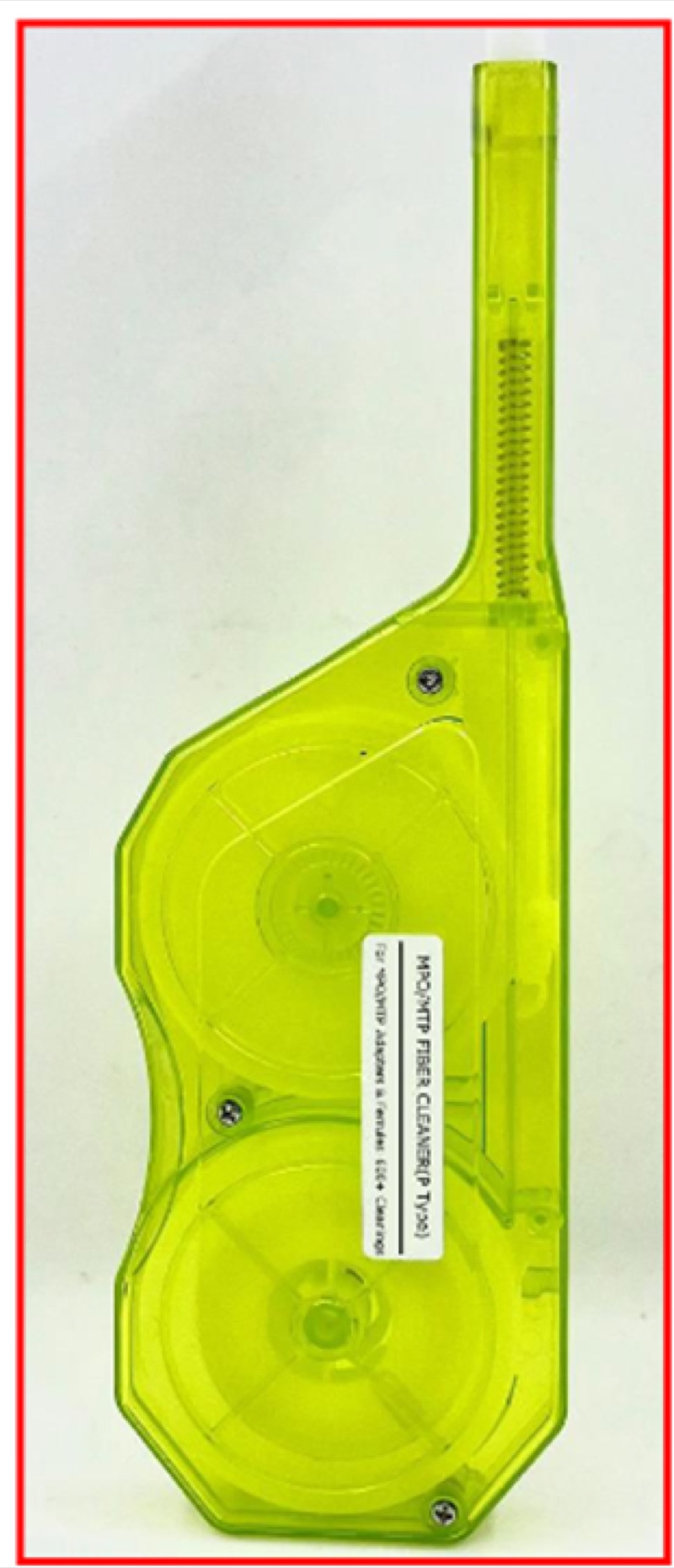
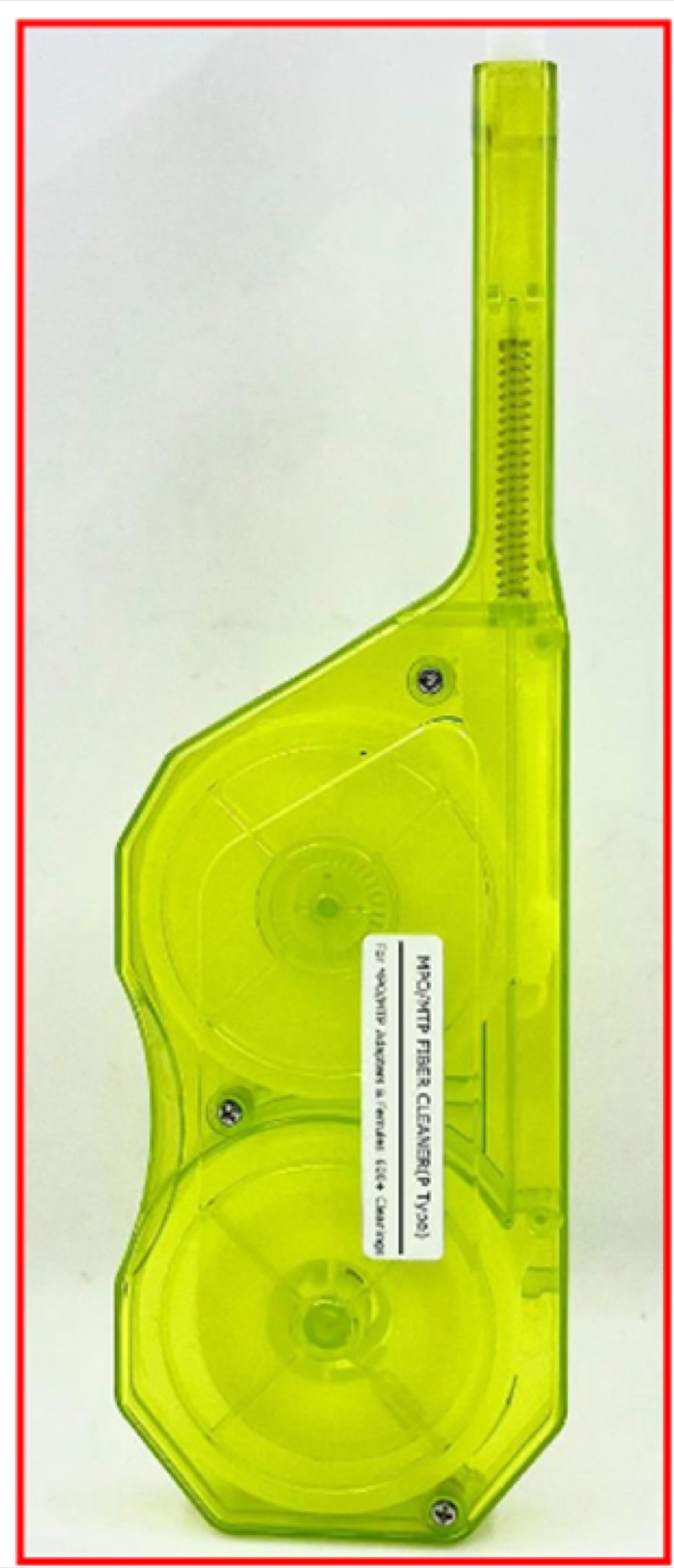
The MPO/MTP Cleaner - P or T Type ($67.99): QBL lists this cleaner for P or T type MPO connectors, 600 cleans. Check which type your connectors are before you order.
R-Type
The MPO/MTP Cleaner - R Type ($109.99): QBL lists this cleaner for R type MPO/MTP connectors, 500 cleans.
Which to Carry
Push-type for field techs who clean a few MPOs per job. R-type for data center operations teams who clean dozens or hundreds of MPOs per shift. Both work; the choice is about volume and form factor.
| Factor | Push-Type (P/T) | R-Type |
|---|---|---|
| Form Factor | Compact, fits truck bag | Larger, bench-friendly |
| Cleans per Cassette | ~600 | ~750+ |
| Speed per Click | ~1 second | ~2 seconds |
| Pinned/Unpinned | Both | Both |
| Best For | Field tech, mixed work | High-volume DC ops |
| Price | $67.99 | $109.99 |
Cleaning Procedure for MPO/MTP
Step 1: Inspect First
Use an MPO-capable inspection scope to capture the end-face image. The scope grades all 12 fibers simultaneously. If any fiber fails, the connector fails. Identify whether contamination is dust (responds to dry clean) or oil (requires wet clean).
Step 2: Identify Pinned or Unpinned
Look at the ferrule. Two protruding pins = pinned (male). Two pin holes = unpinned (female). Most cleaners handle both, but verify yours does before pushing it onto a pinned connector. Pinned connectors require a cleaner with corresponding alignment slots that accept the pins.
Step 3: Position the Cleaner
Align the cleaner head with the MPO ferrule. The guide groove on the ferrule should engage the orientation key on the cleaner. If you cannot insert the cleaner without forcing it, you have the wrong orientation; flip it 180 degrees and try again.
Step 4: Single Click
Push the cleaner straight into the ferrule. Apply steady pressure until you feel the click. One push, one clean. Do not click multiple times in a row; do not push past the click.
Step 5: Re-Inspect
Capture the end-face image again. All 12 fibers should now show clean. If any fiber still has contamination, identify the type. Dust failures repeat with another dry click. Oil failures require wet cleaning.
Step 6: Wet Clean If Needed
MPO wet cleaning is harder than single-fiber wet cleaning because the rectangular ferrule does not lend itself to a wipe-and-rotate technique. Use an MPO-specific wet cleaning cassette if available, or apply 99% IPA to a lint-free wipe and gently drag the wet wipe across the ferrule once. Follow immediately with a dry click to remove any residual solvent.
Step 7: Final Inspection and Mate
Re-inspect to confirm PASS. Mate the connector promptly; do not set it down or leave the ferrule exposed. In a data center environment, even seconds of exposure can deposit dust on the freshly cleaned end-face.
Pinned vs Unpinned Cleaning Considerations
Pinned (Male) Connectors
The two alignment pins protrude beyond the ferrule end-face. A cleaner without alignment slots cannot reach the ferrule because the pins prevent contact. Always verify your MPO cleaner has alignment slots for pinned connectors. The pin surface itself does not need cleaning per se, but contamination on the pins (dust, residue) prevents proper alignment and must be wiped off with a lint-free wipe before mating.
Unpinned (Female) Connectors
The pin holes can collect dust, especially when the connector has been stored without a dust cap. Cleaning the ferrule end-face does not clean the inside of the pin holes. If pin holes appear contaminated, use compressed inert gas (not shop air or canned air) sparingly to dislodge dust from the holes, then re-clean the ferrule.
Polarity Verification
After cleaning and before final mating, verify the polarity of the link. MPO uses Type A, Type B, or Type C polarity schemes. A clean connector mated incorrectly is still a non-functional link. The cleaning workflow is upstream of polarity verification, but both must be correct for the link to work.
Common MPO Cleaning Mistakes
- Using a single-fiber cleaner: A 2.5mm or 1.25mm cleaner cannot clean an MPO ferrule. Use a dedicated MPO cleaner.
- Wrong orientation: Forcing the cleaner against the wrong side of the ferrule damages both. Always engage the guide groove.
- Multiple clicks in a row: One click delivers one fresh ribbon section. Multiple clicks waste ribbon without improving the clean.
- Inspecting only one fiber: All 12 fibers must pass. If your scope only captures one fiber at a time, scan all 12.
- Ignoring pin contamination: Dirty pins cause mating misalignment and ferrule damage. Wipe pins with a clean wipe before mating.
- Skipping dust caps: An exposed MPO ferrule collects dust within seconds. Always cap between cleans and mates.
- Pouring IPA on the connector: Especially bad for MPO because the rectangular ferrule traps liquid. Apply IPA to a wipe first.
- No documentation: Capture the post-clean inspection image. Twelve-fiber connectors that fail later are far easier to troubleshoot when you have a clean baseline.
Building an MPO Field Kit
The field kit for MPO work includes everything for single-fiber connectors plus MPO-specific cleaners. Carry both because most MPO sites also have LC patch panels and SC trunk cables.
MPO Cleaners
One push-type for routine use, plus optional R-type for higher volume.
MPO P or T Type ($67.99) + optional MPO R Type ($109.99)
Single-Fiber Cleaners
For LC and SC connectors that share most MPO sites.
Inspection Scope
MPO-capable scope that grades all 12 fibers simultaneously.
QBL WiFi Fiber Microscope ($1,249.99) with appropriate MPO inspection tip.
The Bottom Line
MPO/MTP cleaning is the highest-stakes cleaning task in the data center. One contaminated fiber in the array fails the entire connector. The cleaning tools are different, the inspection workflow is different, and the failure modes are more numerous than for single-fiber connectors.
Carry a dedicated MPO cleaner. Inspect all 12 fibers after every clean. Treat pinned and unpinned connectors with the same care. The MPO infrastructure carrying your customer's 100G or 400G traffic deserves the same inspect-before-connect discipline as any other fiber, executed with tools designed for the geometry.
For more on the cleaning workflow that supports MPO and single-fiber connectors alike, see Fiber Optic Cleaning Best Practices. For LC and SC procedures, see LC vs SC Cleaning Procedure.