The Two Numbers in Plain English
Insertion Loss
What It Measures
Insertion loss is the reduction in signal power between transmitter and receiver. Inject a known optical power at one end, measure the received power at the other end, and the difference is the insertion loss. Mathematically:
IL (dB) = 10 x log10(P_transmitted / P_received)
A 5 mW transmitter and a 1 mW receiver give 10 x log10(5/1) = 7 dB insertion loss. The standard convention reports insertion loss as a positive dB number, so the larger the IL number, the more signal was lost.
What It Includes
- Fiber attenuation: the inherent loss of light traveling through the glass core (single-mode 0.35 dB/km at 1310nm, 0.22 dB/km at 1550nm)
- Splice loss: 0.05-0.1 dB per fusion splice; up to 0.5 dB per mechanical splice
- Connector loss: 0.3-0.5 dB per pair
- Bend loss: highly variable; tight bends can add 0.5-3 dB or more
- Coupling losses: at fiber type transitions or core size mismatches
How It's Measured
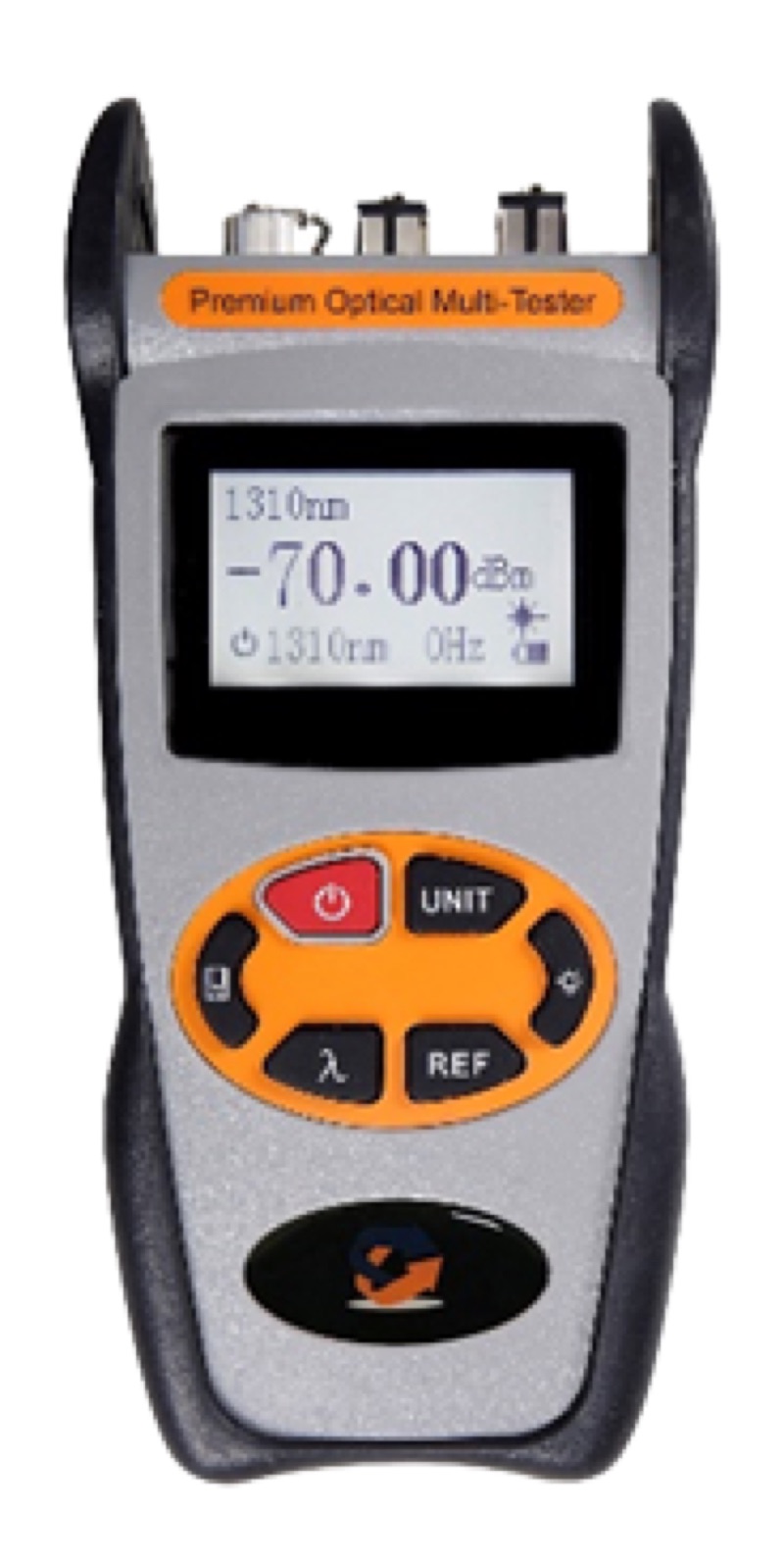
Standard procedure uses a calibrated light source and power meter. Reference the source through a launch cord, then insert the fiber under test in line and measure the loss in dB. The Optical Power Meter LC handles standard wavelengths. For detailed procedure, see How to Test Fiber Link Budget.
Return Loss (Reflectance)
What It Measures
Return loss is the ratio of forward optical power to backward-reflected optical power, measured at a single point (usually a connector or splice). The inverse of return loss is reflectance -- the fraction of light that reflects back. Mathematically:
RL (dB) = -10 x log10(P_reflected / P_incident)
If a connector reflects 1% of incident light, the return loss is -10 x log10(0.01) = 20 dB. If it reflects 0.001%, return loss is 50 dB. Return loss is conventionally reported as a positive dB number, so the bigger the RL number, the less signal reflects (which is what you want).
What Causes Reflections
Anywhere the refractive index changes abruptly along the fiber, light reflects. The biggest reflections come from:
- Connector endfaces: glass-to-air interfaces reflect about 4% per surface unless polished or angled
- Air gaps: dirty or unmated connectors with air between ferrules reflect strongly
- Cracked or chipped endfaces: create refractive index discontinuities at the damage site
- Mechanical splices: the index-matching gel reduces reflections, but degraded splices reflect strongly
- Fiber breaks: a clean break reflects strongly; a shattered break reflects diffusely
UPC vs APC Polish
Connector polish geometry directly determines achievable return loss:
- PC (Physical Contact): domed polish, ferrules touch in the center. RL typically 35-40 dB. Largely obsolete.
- UPC (Ultra Physical Contact): improved domed polish with better surface finish. RL typically 50-55 dB.
- APC (Angled Physical Contact): 8-degree angled polish that directs reflections out of the fiber core. RL typically 60-70 dB.
For more on connector polish geometry, see SC/APC vs UPC Connectors.
How It's Measured
Return loss requires either an OTDR (which measures backscatter and reflective events) or a dedicated optical return loss meter. A standard power meter cannot measure RL because it only sees forward power. The QBL Fiber Ranger Mini OTDR traces the fiber and reports return loss values at each event.
Side by Side Comparison
| Property | Insertion Loss | Return Loss |
|---|---|---|
| What it measures | Total signal loss end-to-end | Reflection at each interface |
| Direction | Forward (TX to RX) | Backward (reflected toward source) |
| Convention | Lower is better | Higher is better |
| Typical good value | 0.5-15 dB | 50-70 dB |
| Standard equipment | Power meter + light source | OTDR or ORL meter |
| Catches | Cumulative loss problems | Bad/dirty connectors, breaks |
| Required for | All link acceptance | High-bandwidth, analog, PON |
| Affected by polish | Slightly | Dramatically (UPC vs APC) |
When Each Measurement Matters
Insertion Loss Always Matters
Every fiber link has an engineered loss budget that the measured insertion loss must not exceed. Insertion loss testing is the universal acceptance test. If the receiver does not see enough signal, the link does not work, period. Insertion loss tells you the fundamental power arrival question.
Return Loss Matters Especially For:
- PON networks with video overlay: the 1550nm analog CATV signal is reflection-sensitive. APC connectors are required throughout the ODN.
- High-bit-rate digital systems (10G+): reflections couple back into laser cavities and cause linewidth broadening, raising the bit error rate.
- Long-haul DWDM: tight return loss specs ensure signal integrity over hundreds of kilometers.
- Test setups using OTDR or coherent receivers: reflections at the launch jumper interfere with measurement accuracy.
Return Loss Matters Less For:
- Short data center fiber (under 100m) at gigabit Ethernet rates
- Basic patch panel verification on enterprise fiber
- Multimode VCSEL-based systems (less reflection-sensitive than DFB lasers)
This does not mean ignore return loss in these applications -- but tight RL specs are not always required.
What Bad Values Tell You
High Insertion Loss
Excess insertion loss means too much signal is being lost somewhere in the path. Investigate in this order:
- Dirty connectors (60% of cases). Click-clean every connector and re-measure.
- Bad fusion splice. OTDR identifies the specific splice exceeding spec.
- Tight bend or kink in the cable. VFL trace shows visible glow at the bend.
- Damaged connector (cracked or scratched endface). Microscope inspection confirms.
- Macro-bend at a tight cable management point or pinch point.
Low Return Loss
Excess back-reflection at a specific point means a bad connection. Causes:
- Air gap between mated connectors (incomplete mating, debris)
- Wrong polish type at one end (mating UPC to APC)
- Cracked or pitted endface
- Severe contamination on the endface
- Damaged ferrule alignment sleeve in the bulkhead
Most return loss problems are connector related and resolve with cleaning, re-mating, or replacement of the affected connector.
Industry Specifications
TIA Specifications
- TIA-568: Building cabling -- single-mode IL maximum varies by class; UPC RL minimum 26 dB, APC RL minimum 55 dB
- TIA-526-7: Single-mode insertion loss test method (Method A.1 single-cord reference)
- TIA-526-14: Multimode insertion loss test method
ITU-T Specifications
- G.651/G.652: Multimode and single-mode fiber attenuation specs
- G.984 (GPON): Connector RL minimum 55 dB UPC, 60 dB APC at all wavelengths
- G.987 (XG-PON), G.9807 (XGS-PON): APC RL minimum 60 dB across operating wavelengths
BICSI Tier Standards
- Tier 1 acceptance: Insertion loss bidirectional at 2 wavelengths plus visual inspection
- Tier 2 acceptance: Tier 1 plus OTDR trace including event-level RL at each connector
Practical Test Workflow
Combining IL and RL testing on a critical link:
- Step 1: Clean every connector in the path. Use the CLEP-25 or CLEP-125.
- Step 2: Inspect each endface with the Wifi Fiber Microscope. Replace any damaged connectors before testing.
- Step 3: Run insertion loss test with calibrated source and power meter, bidirectional at both required wavelengths.
- Step 4: Run OTDR trace from one or both ends. Verify return loss at each connector and splice exceeds spec. Identify any specific events with excess loss.
- Step 5: Document all measurements with fiber ID, wavelengths, IL values, and event-level RL values.
- Step 6: Pass/fail against specification. Address any failures by cleaning, re-mating, or replacing affected connectors and splices.
Frequently Asked Questions
What is the difference between insertion loss and return loss?
Insertion loss is the total signal reduction from TX to RX (lower dB = better). Return loss is the ratio of forward power to back-reflected power at each interface (higher dB = better). IL tells you how much signal arrives. RL tells you how clean each connection is. They catch different problems and both matter for high-performance networks.
What is a good return loss value?
UPC connectors should achieve greater than 50 dB; quality UPC reaches 55-60 dB. APC connectors should achieve greater than 60 dB; quality APC reaches 65-70 dB. Values below 40 dB indicate a contaminated, damaged, or improperly polished connector that needs attention.
When does return loss matter?
RL matters most for high-bit-rate digital systems, analog video on PON (1550nm CATV), and laser-based systems sensitive to back-reflections. PON networks require APC throughout. Long-haul DWDM has strict RL specs. Short data center fiber and basic enterprise patches tolerate lower RL values.
What causes high insertion loss?
Dirty connectors are the number-one cause (adds 0.5-5 dB). Other causes: bad fusion splices, mechanical splice degradation, tight bends, fiber stress at terminations, mismatched fiber types, and connector damage. Always investigate dirty connectors first.
Can a power meter measure return loss?
No. A power meter measures forward power only. Return loss requires an OTDR that detects reflective events from backscatter, or a dedicated ORL meter that measures forward and back-reflected power simultaneously. Use the Fiber Ranger Mini OTDR for event-level RL measurements.
Equipment for IL and RL Testing
- Optical Power Meter LC ($339.99) -- Insertion loss measurement.
- Fiber Ranger Mini OTDR ($579.99) -- Insertion loss plus event-level return loss.
- Wifi Fiber Microscope -- Identify endface damage that causes RL problems.
- CLEP-25 and CLEP-125 -- Clean before every measurement.
Related guides: Test Fiber Link Budget Step by Step, SC/APC vs UPC Connectors, OTDR Basics.