What Ribbon Fiber Cable Actually Is
Ribbon fiber cable bonds 12 individually coated optical fibers side-by-side into a flat matrix called a ribbon. Each fiber retains its own 250-micrometer primary coating with color coding for identification. The fibers are bonded edge-to-edge by a thin polymer matrix that holds them in fixed positions and consistent spacing. The result looks like a tiny ribbon cable about 3 mm wide and 0.3 mm thick, containing 12 fibers in a known geometry.
Multiple ribbons are stacked inside the cable. A 12-fiber ribbon stack with 12 ribbons gives 144 fibers in a remarkably compact cable. A 12-fiber ribbon stack with 36 ribbons gives 432 fibers. Modern hyperscale ribbon cables stack hundreds of ribbons to reach 1728, 3456, or even 6912 fiber counts in cable diameters that would be impossible with traditional loose tube construction at the same fiber count.
Ribbon cable comes in two main flavors. Standard ribbon (matrix-bonded) keeps all 12 fibers permanently bonded edge-to-edge. Rollable ribbon (also called partially-bonded or intermittent-bonded ribbon) bonds the fibers loosely, allowing the ribbon to "roll" into a more compact bundle when not under tension. Rollable ribbon enables even higher fiber density and easier handling but requires slightly different splicing procedures.
Ribbon vs Loose Tube Cable Specifications
| Property | Ribbon | Loose Tube (Stranded) |
|---|---|---|
| Max Fiber Count | 6912 strands | 1728 strands (high-density) |
| Fibers per Splice | 12 (mass fusion) | 1 (single fusion) |
| Time per Fiber Splice | 5-7 seconds | 60-90 seconds |
| Cable Diameter (288 fibers) | 14-18 mm | 20-25 mm |
| Splicer Required | Ribbon fusion splicer | Single-fiber splicer |
| Splicer Cost | $15,000-$30,000 | $5,000-$15,000 |
| Best Use | High-fiber-count, mass splicing | Mid-fiber-count, flexible splicing |
The Mass Fusion Splicing Advantage
The reason ribbon fiber exists is mass fusion splicing. A ribbon fusion splicer aligns all 12 fibers in a ribbon simultaneously and produces all 12 splices in a single arc operation. The actual splicing arc takes about 5 seconds; total cycle time including stripping, cleaving, alignment, splicing, and protection sleeve heating is 60-90 seconds for an entire 12-fiber ribbon.
Compare to single-fiber splicing: 60-90 seconds per fiber means a 12-fiber bundle takes 12-18 minutes. Mass fusion finishes the same 12 fibers in 60-90 seconds. That is a 10-12x productivity improvement on the splicing operation itself, plus additional savings on the preparation steps because all 12 fibers are stripped and cleaved together using ribbon-specific tools.
For a project with 1000 splices, single-fiber splicing might take 100 hours of splicer time. Mass fusion splicing of the equivalent 1000-fiber ribbon project takes about 8-10 hours. At typical contract splicing labor rates of $150-200/hour for a qualified technician, the labor savings on a single project can be tens of thousands of dollars.
For more on splicer selection see our fusion splicer guide and the ribbon fusion splicer we stock for projects requiring mass fusion capability.
Where Ribbon Fiber Wins
FTTH Urban and Suburban Backbone
FTTH deployments aggregate hundreds or thousands of subscriber drops onto trunk fiber that runs from the central office to neighborhood splitters or remote terminals. A neighborhood serving 5000 subscribers needs at least 5000 fibers in the backbone (one per subscriber) plus spares. Ribbon cable in 1728 or 3456 fiber counts handles this in a single cable that fits in standard duct sizes. Splicing the backbone segments using mass fusion splicers cuts deployment timelines significantly.
Hyperscale Data Center Interconnect
Hyperscale data centers (Microsoft, Google, Meta, Amazon facilities) interconnect dozens of buildings on a single campus with massive fiber bundles. A single inter-building cable might carry 6912 fibers, all of which need to be spliced at each end. Ribbon cable with mass fusion splicing is the only practical way to handle the volume. The same equipment is used for the spine-and-leaf architecture inside the data center where MPO trunk cables connect rows of switches.
Long-Haul Backbone
Telecom long-haul fiber routes between cities use ribbon cable to maximize fiber count per duct. A 432-fiber ribbon cable in a single 1.25-inch duct provides as much capacity as four separate 144-fiber loose tube cables, freeing duct space for future installations or for other utilities sharing the same trench. The mass fusion splicing efficiency makes it economically viable to deploy and maintain the high fiber counts.
Building Risers in High-Density Buildings
Tall office buildings, hospitals, and university campuses with extensive fiber requirements between floors benefit from ribbon construction. A 144 or 288-fiber ribbon cable in a riser pathway provides headroom for current needs and future growth. Indoor riser-rated ribbon cable is available with OFNR jackets.
Where Ribbon Fiber Does Not Make Sense
Low-Fiber-Count Cables
For cables with 12-72 fibers, ribbon construction provides no meaningful advantage. The cable diameter savings are small at low fiber counts, and the requirement for ribbon splicing equipment adds capital cost without proportional labor savings. Standard loose tube construction with single-fiber splicing is the right choice.
FTTH Drop Cable
FTTH drops to individual subscribers are typically 1, 2, or 4-fiber cables. Ribbon construction is meaningless at these counts. Drops use single-fiber or duplex tight-buffered or loose-tube construction.
Patch Cords
Indoor patch cords use individual tight-buffered fibers, not ribbons. The ribbon format is not designed for the frequent moves and changes of patch panel work.
Operations Without Ribbon Splicer Access
Ribbon cable requires ribbon fusion splicers, ribbonizing tools, and trained technicians. Smaller contractors who do not have access to this equipment cannot terminate ribbon cable economically. If your operation primarily uses single-fiber splicers, stick with loose tube cable for the projects you take on.
Ribbon Cable Construction in Detail
Standard 12-Fiber Ribbon
A 12-fiber ribbon contains 12 individually colored fibers (blue, orange, green, brown, slate, white, red, black, yellow, violet, rose, aqua per TIA-598) bonded edge-to-edge in a fixed order. The ribbon's color sequence allows technicians to identify any specific fiber position quickly. The bonding matrix is designed to allow easy ribbon stripping for splicing while maintaining ribbon integrity during cable installation.
24-Fiber Ribbon
Some manufacturers offer 24-fiber ribbons for ultra-high-density applications. The 24-fiber ribbon uses two color groups (the standard 12-color sequence repeated, with the second group identified by a stripe or different shade). Mass fusion splicing of 24-fiber ribbons requires specialized splicers; not all ribbon splicers support 24-fiber operation.
Stranded Ribbon Cable
The classic ribbon cable design stacks ribbons inside a buffer tube, with the entire stack twisted helically (S-Z stranded) inside the cable. Stranded ribbon cables top out at around 1728 fibers. Common configurations: 144-fiber (12 ribbons), 288-fiber (24 ribbons), 432-fiber (36 ribbons), 864-fiber (72 ribbons).
Central Tube Ribbon
Central tube designs place all the ribbons inside a single large central buffer tube, eliminating the strength member that runs through the middle of stranded designs. This allows higher fiber densities (up to 3456 fibers) but requires careful ribbon management during installation to avoid twisting.
Rollable Ribbon Cable
Rollable ribbon (or partially-bonded ribbon) bonds the 12 fibers loosely instead of edge-to-edge. The ribbon can roll into a tighter bundle when not under tension, allowing higher fiber density (up to 6912 fibers) in the smallest cable diameters. Rollable ribbon requires ribbon splicers that support rollable format. The technology is dominant in newer hyperscale data center builds.
Splicing Ribbon Cable in the Field
The mass fusion splicing workflow for ribbon cable is significantly different from single-fiber splicing:
- Open the cable jacket and identify the ribbon stack
- Carefully separate the desired ribbon from the stack
- Strip the entire ribbon's matrix using a ribbon stripper (mechanical or thermal)
- Clean the 12 exposed bare fibers with isopropyl alcohol
- Cleave all 12 fibers simultaneously with a ribbon cleaver
- Place the prepared ribbon in the splicer's V-groove array
- Repeat the prep on the other ribbon to be spliced
- Close the splicer and run the splice cycle (about 5-10 seconds for the arc itself)
- Heat the protection sleeve over the spliced ribbon
- Place the protected splice in a ribbon splice tray and secure
Equipment Required for Ribbon Work
Ribbon Fusion Splicer
The defining equipment investment for ribbon work. Modern ribbon splicers from Sumitomo, Fujikura, and INNO Instrument support 12-fiber ribbons (and increasingly 24-fiber and rollable formats). Expect to invest $15,000-$30,000 for a quality ribbon splicer with the necessary holders and accessories. See the ribbon fusion splicer we stock.
Ribbon Cleaver
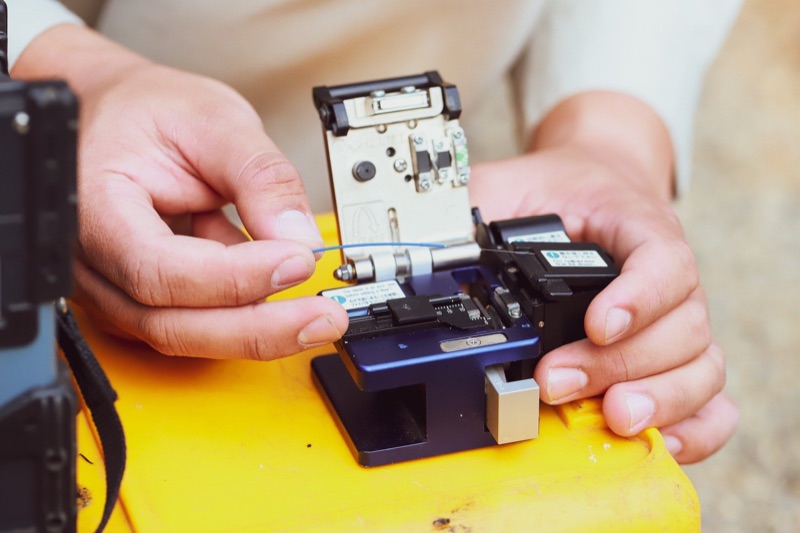
A specialized cleaver that handles 12 fibers simultaneously. Ribbon cleavers use a wider blade and broader fiber clamp than single-fiber cleavers. Quality is paramount; a poor cleave ruins the entire ribbon splice.
Ribbon Stripper (Thermal or Mechanical)
The matrix bonding the 12 fibers together must be removed before cleaving. Thermal strippers (using a controlled heated element) are gentler on the fibers; mechanical strippers are faster but require careful technique to avoid scoring the fibers.
Ribbonizing Tools
For converting between ribbon and single-fiber formats (sometimes needed for splicing ribbon cable to a single-fiber pigtail at a termination point), ribbonizing kits hold individual fibers in the correct geometry for ribbon splicing. Used less often as ribbon-to-ribbon splicing dominates the workflow.
Frequently Asked Questions
What is ribbon fiber cable?
Ribbon fiber cable bonds 12 (or 24) individually coated fibers side-by-side into a flat matrix ribbon. Multiple ribbons are stacked inside the cable, allowing very high fiber counts (up to 6912 fibers) in a small cable diameter. Ribbons enable mass fusion splicing, where all 12 fibers in a ribbon are spliced simultaneously to another ribbon in 30 seconds, dramatically reducing splice time per fiber.
When should I use ribbon fiber cable?
Use ribbon fiber when you need high fiber count in a small cable diameter (typically 432 fibers or more), when splice labor cost is a major project component, and when you have access to ribbon splicers and ribbonizing tools. FTTH backbone, hyperscale data center interconnect, and metro network builds with hundreds or thousands of fibers are typical applications.
Can a regular fusion splicer splice ribbon fiber?
No. Single-fiber fusion splicers can only splice one fiber at a time. Splicing ribbon fiber requires a ribbon fusion splicer, which has a wider electrode arc and fixtures designed to align all 12 fibers in a ribbon simultaneously. Ribbon splicers cost significantly more than single-fiber splicers but reduce splice time per fiber by 10-12x.
What is rollable ribbon fiber?
Rollable ribbon (also called partially-bonded or intermittent-bonded ribbon) bonds the 12 fibers loosely instead of edge-to-edge. The ribbon can roll into a tighter bundle when not under tension, allowing higher fiber density in the smallest cable diameters. It enables ultra-high-density cables up to 6912 fibers but requires ribbon splicers that support rollable format.
Is ribbon fiber more expensive than loose tube?
The cable cost per fiber is similar to loose tube. The total project cost for ribbon-based deployments is significantly lower when you factor in splicing labor: mass fusion splicing reduces per-fiber splice time by 10-12x. The break-even point depends on splice volume; projects with 500+ splices typically save more on labor than they spend on the ribbon splicer investment.
Related Reading
- Loose Tube vs Tight Buffered Fiber -- the construction alternatives ribbon competes with.
- Best Fusion Splicers for FTTH -- splicer selection including ribbon-capable models.
- Fiber Cable Construction Explained -- layer-by-layer breakdown of cable structure.
Shop Ribbon Fusion Splicers
Ribbon fusion splicers and standard fusion splicers for any project scale, from FTTH drops to hyperscale interconnect.