The two-question framework
If you remember nothing else from this article, remember this. Before you order a single spool of fiber, answer two questions in this order:
- How long is the link, today and twenty years from now?
- What do the optics on each end cost?
Everything else, including jacket type, fiber count, connector style, and termination method, flows from those two answers. We have watched contractors agonize over OM4 versus OS2 cable pricing while ignoring the fact that the SFP+ optics on the switches will cost ten times more than the entire cable. Get the framework right and the rest is detail work.
Distance: the hard physics
Distance is not negotiable. Fiber type sets a hard ceiling on how far light can travel before the receiver gives up. Here are the working numbers a network designer should have memorized:
Multimode reach
- OM3 at 10G: 300 meters
- OM4 at 10G: 400 meters
- OM4 at 40G/100G SR4: 100 to 150 meters
- OM5 at 100G SWDM4: 150 meters
Singlemode reach
- OS2 at 10G LR: 10 kilometers
- OS2 at 100G LR4: 10 kilometers
- OS2 at 100G ER4: 40 kilometers
- OS2 at 100G ZR: 80 kilometers and beyond
Notice the gap. Multimode tops out around 400 meters at 10G and shrinks dramatically as data rate climbs. Singlemode comfortably covers ten kilometers at any speed under 400G. If your cable run is anywhere between 400 meters and the far horizon, singlemode is the only honest answer. We cover the underlying physics in our Single-Mode vs Multi-Mode Fiber article.
Optics economics: where the real money lives
Cable cost is a rounding error. Transceivers are the budget. Here are typical 2026 street prices for branded optics:
| Optic | Type | Reach | Street Price (each) |
|---|---|---|---|
| 10G SR | Multimode | 300m OM3 / 400m OM4 | $25 to $60 |
| 10G LR | Singlemode | 10 km | $80 to $200 |
| 10G ER | Singlemode | 40 km | $300 to $700 |
| 40G SR4 | Multimode | 150m OM4 | $200 to $500 |
| 40G LR4 | Singlemode | 10 km | $700 to $1,500 |
| 100G SR4 | Multimode | 100m OM4 | $300 to $700 |
| 100G LR4 | Singlemode | 10 km | $1,000 to $2,500 |
For a 48-port leaf switch carrying 10G uplinks to a spine, the difference between SR and LR optics across 96 transceivers (48 pairs) is roughly $5,000 in favor of multimode. That savings dwarfs any cable cost difference.
This is why hyperscale data centers still buy oceans of OM4. Reach inside a row is short, port density is enormous, and SR optics economics are unbeatable. Outside the data center, the economics flip. A campus with three 10G LR optics per building beats fighting the multimode distance ceiling forever.
Test those expensive optics with a calibrated handheld optical power meter and a matched stabilized light source before you certify the link. Optics fail; document them out of the path early.
The four common project types
Data center inside one room
Default to OM4 multimode. Reach is short, density is high, and SR optics dominate. Order pre-terminated MTP/MPO trunks for the highest fiber count runs and breakout cassettes for the LC patch panels. Stock LC duplex patch cords for tight rear-of-rack patching. If you anticipate moving to 400G in the next refresh, evaluate OM5 SWDM optics, but for most sites OM4 will carry you through 100G fine.
Campus backbone, building to building
Default to OS2 singlemode. Once you cross a parking lot, you are past 100 meters and probably past 200. Singlemode gives you 10 km of headroom at 10G, 40G, and 100G with the same cable. Pull a high count, terminate what you need now, and leave dark fibers for whatever comes in 2030. Use a fusion splicer at the building entrance to land the OSP cable into ISP riser cable.
FTTH or PON deployment
Always OS2 singlemode. PON systems use 1310, 1490, and 1577 nm wavelengths and rely on singlemode characteristics for the splitter loss budget. Multimode is not even an option in modern XGS-PON or 25G PON gear. Our FTTH deployment guide walks through the cable selection in detail.
Single building riser, four floors
This is the hardest decision. Run lengths are around 100 to 200 meters, both fiber types work, and the optics question becomes the tiebreaker.
- If the IT team uses standardized SR optics in their existing data center, mirror that and run OM4. Fewer SKUs, lower spares cost.
- If the building may be repurposed or expanded, run OS2 to future-proof. The cable will outlive three generations of switches.
- If you have budget, run a hybrid trunk with both fiber types in one jacket. Costs slightly more per foot but eliminates the decision permanently.
The future-proofing trap
Every contractor we know has heard the phrase "let's just put in singlemode for future-proofing" on a 50-meter switch-to-switch link. Sometimes it is the right call. Often it is overspending.
Future-proofing only matters if the future actually arrives. Inside a 50-meter run between two switches in the same MDF, the cable will probably get replaced in the next refresh anyway. The pathway is accessible, the cable is short, and the cost of pulling new fiber later is trivial compared to the optics premium you pay today on every port.
Future-proofing is most valuable when:
- The pathway is sealed (concrete, conduit poured, drywall finished)
- The run is long enough that re-pulling is expensive
- The bandwidth trajectory is uncertain
- The cost premium is small relative to the project budget
For a 12-strand riser between MDF and IDF on floor 4 of a 20-floor building, run OS2. The walls are not coming down again. For a 50-meter trunk inside an open-frame data center, run OM4 and budget for replacement at the next switch refresh.
The decision matrix
| Scenario | Recommended Fiber | Reason |
|---|---|---|
| Inside one data center room | OM4 | SR optics economics dominate |
| Building to building, under 400m | OS2 | OSP path, future-proof, marginal cost |
| Building to building, over 400m | OS2 | Multimode cannot reach |
| FTTH access network | OS2 | PON requires singlemode |
| Long-haul metro | OS2 G.652.D or G.655 | Coherent optics over 80 km |
| Riser, single building, under 200m | OM4 or hybrid | Optics cost vs future-proof tradeoff |
| Industrial floor, harsh environment | OM3 with armor | Short reach, rugged jacket |
| Wireless small cell backhaul | OS2 | Distance varies, future bandwidth grows |
Connector and termination implications
Once you choose the fiber type, several downstream decisions become easy:
If you chose multimode
- Connectors are typically UPC, never APC. Multimode does not use angled polish.
- Termination is fast: pre-terminated MTP trunks, OptiTap or LC pigtails, mechanical splices for emergency repairs.
- Cleaning is critical because the larger 50 micron core is more forgiving but VCSELs are sensitive to angular errors. Always clean with a one-click cleaner and verify with a microscope.
- Bandwidth is sometimes labeled in EMB (effective modal bandwidth) MHz·km. OM4 is rated 4,700 MHz·km, OM5 is rated 4,700 MHz·km at 850 nm and 2,470 MHz·km at 953 nm.
If you chose singlemode
- Connectors should be APC for any path carrying analog video, RFoG, or PON wavelengths. UPC is acceptable for digital data center singlemode but APC is becoming the default. See our APC vs UPC guide.
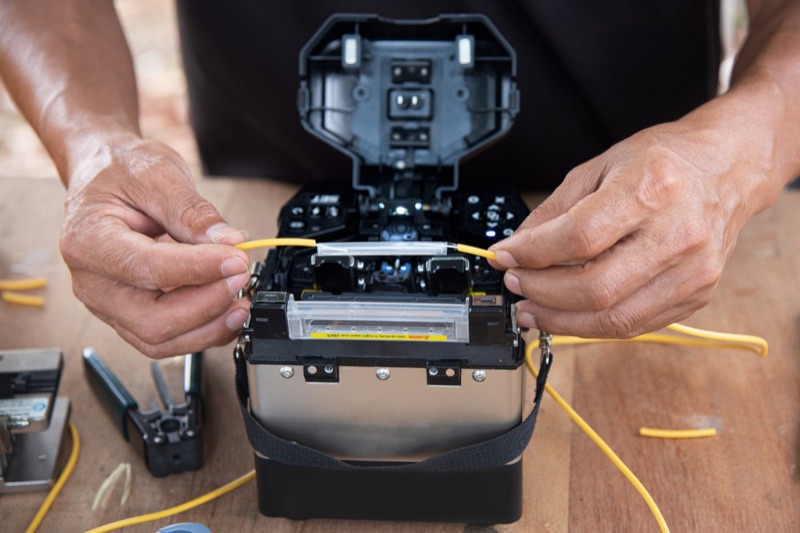
- Fusion splicing is the gold standard. Mechanical splices are emergency only. Plan for a fusion splicer on the truck for any project over a few terminations.
- Bend radius matters more on G.652 than on G.657, but always honor the manufacturer minimum.
- OTDR testing should use both 1310 and 1550 nm. Bend events show up at 1550 first.
The cost of being wrong
Picking the wrong fiber type is one of the few mistakes that requires ripping cable out of the wall. The penalty for over-specifying singlemode is paying $50 extra per optic. The penalty for under-specifying multimode is repulling cable through finished pathways and explaining to the customer why the brand new gigabit Ethernet circuit will not light at 10G.
When in doubt, lean toward singlemode for OSP and backbone, and lean toward multimode only when SR optics economics clearly justify it. The market is moving toward singlemode everywhere it is technically practical, and that trend will continue as silicon photonics drives optic prices down across all wavelengths.
Documentation requirements
Once installed, document everything. Every fiber pair gets:
- Fiber type (OM3/OM4/OM5 or OS2)
- Connector type and polish (LC/UPC, SC/APC, etc.)
- Bidirectional OTDR trace at appropriate wavelengths
- Insertion loss measured with power meter and light source
- Length measurement
- Pathway and termination panel labels
This protects you when someone six years later asks "can this run handle 100G?" and you can answer with measured data, not a guess.
FAQ
When should I always pick singlemode?
Choose singlemode whenever the link exceeds 400 meters, when you need 10G or higher across a campus, when the cable serves an OSP or backbone path, or when you cannot predict bandwidth growth over the next decade. The optics premium is worth it for unrecoverable pathways.
When does multimode still win?
Multimode wins inside data centers and equipment rooms where reach is under 100 meters, port density is high, and SR optics cost a fraction of LR optics. OM4 and OM5 with VCSEL transceivers remain the lowest cost-per-port for short links. Hyperscale operators buy multimode in millions of strands.
Is fiber cost or optic cost more important?
Optics dominate the budget. A pair of singlemode optics can cost five to ten times more than a multimode pair, while singlemode cable is only marginally cheaper than OM4. Always price the optics first, then choose the fiber to match. Multiply optic cost by port count and the answer becomes obvious.
Can I mix multimode and singlemode in the same trunk?
Yes, hybrid trunks are common. You order a cable with both fiber types under one jacket. Just label the breakouts clearly and never patch a multimode jumper into a singlemode pathway, the loss is severe (typically over 20 dB) and the link will not work. Use color-coded panels to keep them separate.
Should I install singlemode even for a 100m run?
If the optics cost is not a barrier and the path may extend later, singlemode future-proofs the run. For pure 100m switch-to-switch links inside one building where the cable will be replaced at the next refresh anyway, OM4 with SR optics is still the cheaper deployment today.
What about OM5 wideband multimode?
OM5 is OM4 with extended bandwidth at 953 nm to support SWDM (shortwave wavelength division multiplexing). It costs roughly 50 percent more than OM4 and only pays back if you actually deploy SWDM optics. For most projects, OM4 is the better economic choice unless you have a specific 100G SWDM4 roadmap.
Can singlemode optics light multimode cable?
No, never. Launching 1310 or 1550 nm singlemode laser light into a 50 or 62.5 micron multimode core creates massive coupling loss and modal noise. The link will either not light at all or will run with severe error rates. Always match optic wavelength and core size.
Related Reading
Ready to spec your project?
Browse fiber test gear, fusion splicers, and inspection tools at ShopFiberOptic, or contact our team for project-specific guidance on cable, optics, and tooling selection.