Quick Decision
What "Single Wavelength" Actually Means
A single-wavelength power meter has one photodetector that measures whatever light hits it, but the internal calibration applies to one wavelength at a time. You select the wavelength setting (typically 850, 1310, 1490, 1550, or 1625nm), and the meter applies the calibration table for that wavelength to convert detector current into a dBm reading.
To measure at two wavelengths, you make two separate measurements: set the wavelength to 1310nm and your light source to 1310nm, take the reading, then change both to 1550nm and take another reading. Each requires re-establishing the reference, which doubles your setup time.
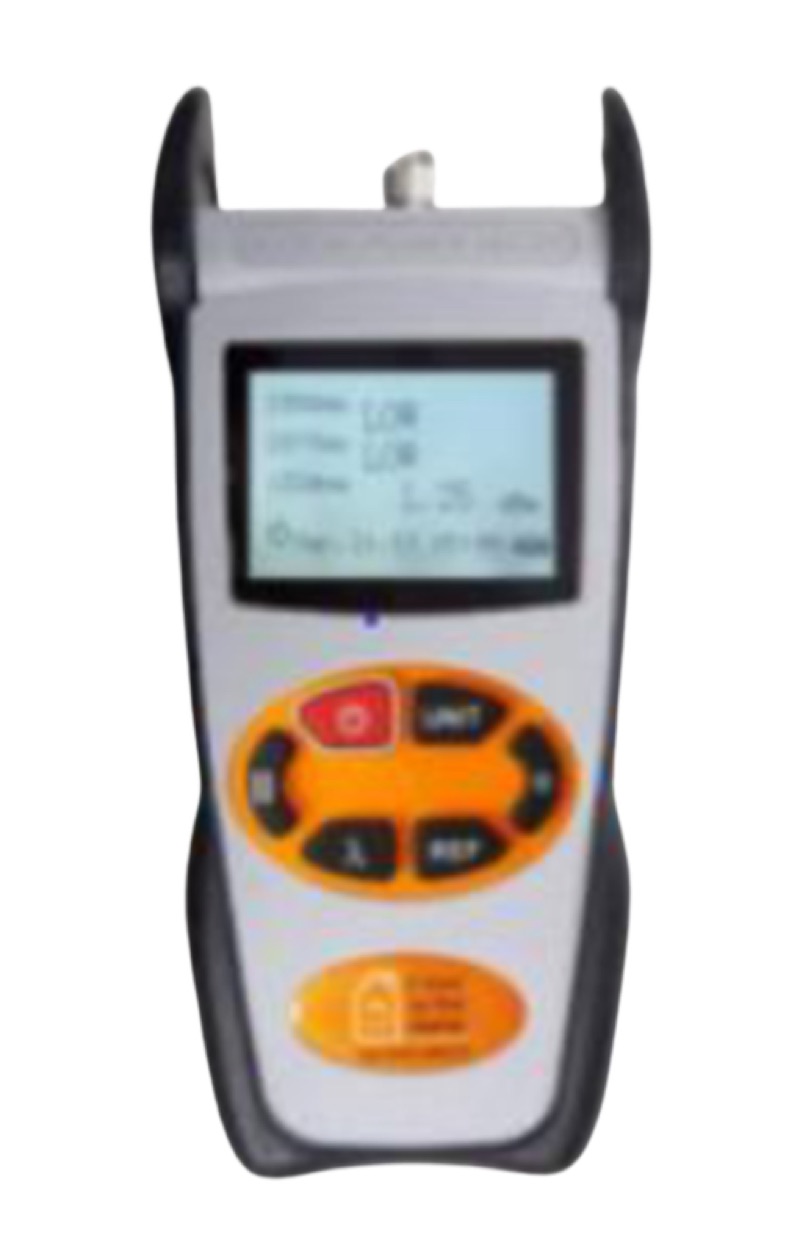
The Optical Power Meter LC is a single-wavelength meter -- it measures one wavelength per measurement cycle. It cycles through the standard wavelengths via the wavelength button and applies the appropriate calibration for whichever wavelength you select.
What "Dual Wavelength" Means
A dual-wavelength power meter contains optics that split incoming light to two detectors -- or filters that separate two specific wavelengths to a single detector with electronic switching. Either way, the meter displays two power readings simultaneously, one for each wavelength.
How the Optics Work
The most common implementation uses a wavelength-division multiplexer (WDM) or thin-film filter that splits the input. Light at 1310nm goes to one detector path; light at 1550nm goes to another. Each path has its own calibration. The meter reads both detectors and displays both values.
An alternative implementation uses a single broadband detector with electronic wavelength tone detection. The light source modulates each wavelength at a different frequency (commonly 270 Hz for 1310nm and 330 Hz for 1550nm), and the meter electronically separates the two by frequency to display each.
What You See
On the display, both wavelength readings appear at once. Connect the fiber, see -3.21 dB at 1310 and -3.05 dB at 1550, no setup change required. For acceptance testing where each fiber must be documented at both wavelengths, the time savings are substantial.
Side by Side
| Feature | Single Wavelength | Dual Wavelength |
|---|---|---|
| Measures at once | 1 wavelength | 2 wavelengths |
| Test time per fiber | ~2 min (both wavelengths) | ~30 sec (both wavelengths) |
| Setup changes per wavelength | Yes (toggle source + meter) | No |
| Source required | Single or dual wavelength | Dual wavelength |
| Cost | $80-300 | $200-600 |
| Best for | Occasional testing, one wavelength | Production acceptance testing |
Why Most Specs Require Two Wavelengths
Single-mode fiber attenuation is wavelength dependent. At 1310nm, typical attenuation is 0.35 dB/km. At 1550nm, it drops to 0.22 dB/km. The two wavelengths also respond differently to bend losses -- 1550nm light is more sensitive to macro-bends than 1310nm light. A bend that adds 0.1 dB at 1310nm might add 1.0 dB at 1550nm, which is critical to catch.
For multimode fiber, attenuation is roughly 3 dB/km at 850nm and 1 dB/km at 1300nm. Multimode acceptance specs require both wavelengths because the signal-to-noise margin is much tighter at 850nm where attenuation dominates.
Standards That Require Dual Wavelength
- TIA-526-7: Single-mode link insertion loss -- specifies measurement at 1310 and 1550nm
- TIA-526-14: Multimode link insertion loss -- specifies measurement at 850 and 1300nm
- IEC 61280-4-1/2: International standards for single-mode and multimode link testing -- both require dual wavelength
- BICSI Tier 1/2 acceptance: Building cable plant certification typically requires dual wavelength
- FOA CFOT certification: Practical examination requires dual-wavelength testing
If you are doing acceptance testing for compliance with any of these specifications, dual-wavelength measurement is required. You can do it with a single-wavelength meter by repeating the test at each wavelength, but the test record must document both.
PON Power Meters: Multi-Wavelength on Steroids
PON power meters are wavelength-selective dual or multi-wavelength meters tuned for PON-specific wavelengths rather than the generic 1310/1550 pair. The XGS/GPON Power Meter measures four wavelengths simultaneously: 1310nm and 1490nm for GPON, 1270nm and 1577nm for XGS-PON.
How PON Filters Differ
Standard dual-wavelength meters use broad filters that pass anything in the 1300-1330nm range as "1310" and anything in the 1530-1570nm range as "1550." PON meters use narrow bandpass filters with sharp cutoff edges, typically 5-10nm wide, that isolate just the PON wavelength of interest. This sharp filtering is necessary to separate adjacent PON wavelengths -- 1490nm GPON downstream and 1577nm XGS-PON downstream are far enough apart for broad filters, but 1577nm and 1550nm video overlay are dangerously close.
Pass/Fail Thresholds
PON meters add configurable pass/fail thresholds that simplify mass activation work. Set the threshold range to match the ONT receiver sensitivity, and the meter shows green pass / red fail rather than just a number. Speeds up activations significantly when you are measuring 50+ ONTs in a workday.
For a wavelength-by-wavelength PON meter comparison, see GPON vs XGS-PON Power Meters.
Which Wavelength Setup Fits Your Work
FTTH Installer (GPON or XGS-PON)
You need a PON meter -- not a generic dual-wavelength meter. The XGS/GPON Power Meter ($484.99) measures all four GPON+XGS-PON wavelengths simultaneously, which is faster than any dual-wavelength meter and required for live PON work.
OSP Acceptance Testing
For dark fiber acceptance, dual-wavelength saves significant time. If you test more than 20 fibers per project, dual-wavelength meter and source pay for themselves quickly. If you test fewer fibers occasionally, a single-wavelength meter handles the same job in twice the time at one-third the cost.
Data Center Patch Verification
Most data center fiber is multimode for short reach (under 300m). Dual-wavelength meters covering 850/1300nm cut acceptance test time substantially when there are hundreds of patches to verify. For one-off troubleshooting, single-wavelength is fine.
Training, Education, Lab Use
Single-wavelength meters are perfectly adequate for training labs and educational use where the goal is to demonstrate measurement principles rather than accelerate production testing. A simple Optical Power Meter LC ($339.99) illustrates the concept clearly without the complexity of dual-wavelength interpretation.
Single-Wavelength Network
Some specialized networks operate at only one wavelength -- coarse WDM channels, isolated transmission systems, certain industrial fiber. A single-wavelength meter set to that specific wavelength is the natural fit. Dual-wavelength is unnecessary for these cases.
Buying Considerations
Source Compatibility
A dual-wavelength meter is only useful with a dual-wavelength source. The two must produce signals the meter can recognize and separate. Mixed-brand setups sometimes work but verify before relying on it. A matched source-meter pair from the same manufacturer always works correctly.
Wavelength Coverage
Generic dual-wavelength meters cover 1310/1550 (single-mode) or 850/1300 (multimode). Triple-wavelength meters add 1625nm for OTDR/PON coexistence testing. PON meters cover 4-7 PON-specific wavelengths. Match the meter's wavelengths to the network you actually test.
Connector Type
SC is the most common in FTTH and outside plant. LC is dominant in data centers. The Optical Power Meter LC has an LC interface. The XGS/GPON Power Meter uses SC. Universal 2.5mm adapters accept SC/FC/ST but require an LC adapter for LC connections.
Display and Logging
For documentation-heavy work, a meter with USB or Bluetooth data logging eliminates manual transcription errors. For occasional troubleshooting, a basic display works fine.
Frequently Asked Questions
What is a dual wavelength power meter?
A dual wavelength meter measures two wavelengths simultaneously through wavelength-selective optics or electronic tone detection. Most common pairings are 1310/1550nm for single-mode and 850/1300nm for multimode, cutting test time roughly in half versus single-wavelength meters that require setup changes per wavelength.
Do I need a dual wavelength meter for single-mode fiber?
Most single-mode acceptance specs require both 1310 and 1550nm measurements because attenuation differs at each. You can do this with a single-wavelength meter by testing each wavelength separately. Dual-wavelength does both in one shot. For high-volume acceptance, dual-wavelength is significantly faster.
Is a PON power meter the same as a dual wavelength meter?
Conceptually similar but optically different. Dual-wavelength meters use broad filters at 1310/1550nm. PON meters use narrow bandpass filters tuned to specific PON wavelengths (1490, 1310, 1577, 1270nm) plus configurable pass/fail thresholds. PON meters are wavelength-filtered multi-wavelength meters.
How does dual wavelength testing work?
The dual-wavelength source emits two wavelengths simultaneously, often modulated at different tone frequencies (270 Hz / 330 Hz). The meter detects both, separates them via filtering or frequency demodulation, and displays both readings at once with no setup change between wavelengths.
What is wavelength autodetect?
Some sources transmit a low-frequency tone that identifies the wavelength being sent. A meter with autodetect reads this tone and switches calibration automatically, eliminating wrong-wavelength measurement errors. Same-brand source-meter combinations typically support autodetect; mixed brands may not.
Power Meter Lineup
Match the meter to your work:
- Optical Power Meter LC ($339.99) -- Single-wavelength selectable, ideal for occasional point-to-point testing.
- XGS/GPON Power Meter ($484.99) -- 4-wavelength PON meter for FTTH.
- 25G PON Power Meter ($1,059.99) -- 5-wavelength PON meter including 25G-PON.
- PON Power Meter Pro ($1,639.99) -- Multi-wavelength PON including NG-PON2.
Read the deeper buying guides: Best Fiber Optic Power Meters 2026 and GPON vs XGS-PON Power Meters.