Origin and Standards
The E2000 connector was developed by Diamond SA, a Swiss precision manufacturer, in the 1990s. Its full name is E-2000®, and in some literature it is referred to as LSH (Limited Space Homologation). The connector is standardized under IEC 61754-15 and is widely deployed in European telecommunications networks, particularly in carrier networks, undersea cable terminals, and data centers operated by European carriers.
The defining feature is the spring-loaded shutter that blocks the optical path when the connector is unmated. This shutter automatically closes when the connector is removed from an adapter and opens when re-inserted. No other major connector standard includes a shutter as a fundamental design element.
Mechanical Design
Key Specifications
- Ferrule diameter: 2.5mm ceramic (zirconia)
- Latching mechanism: Push-pull with side-release latch
- Form factor: Rectangular plastic housing similar to SC
- Shutter: Spring-loaded automatic open/close
- Polish types: PC, UPC, and APC available
- Insertion loss: Typical 0.15-0.30 dB
- Return loss (UPC): greater than -50 dB
- Return loss (APC): greater than -65 dB
How the Shutter Works
The E2000 adapter contains a spring-loaded plate that covers the optical path when no connector is inserted. When an E2000 connector is inserted, the connector body pushes the shutter aside as it engages, exposing the ferrule and creating the optical path. When the connector is removed, the spring forces the shutter back into the closed position automatically.
The shutter is keyed so that it can only be opened by a properly oriented E2000 connector. A finger, a fiber inspection scope, or any other object that might trigger eye exposure cannot open the shutter. This is the safety feature that justifies E2000's premium cost in high-power applications.
Latching Mechanism
The E2000 uses a side-release latch with a push-pull engagement. The latch is operated by squeezing a lever on the side of the connector body. This mechanism is similar to SC but with the lever positioned for one-handed engagement and release in dense panel applications.
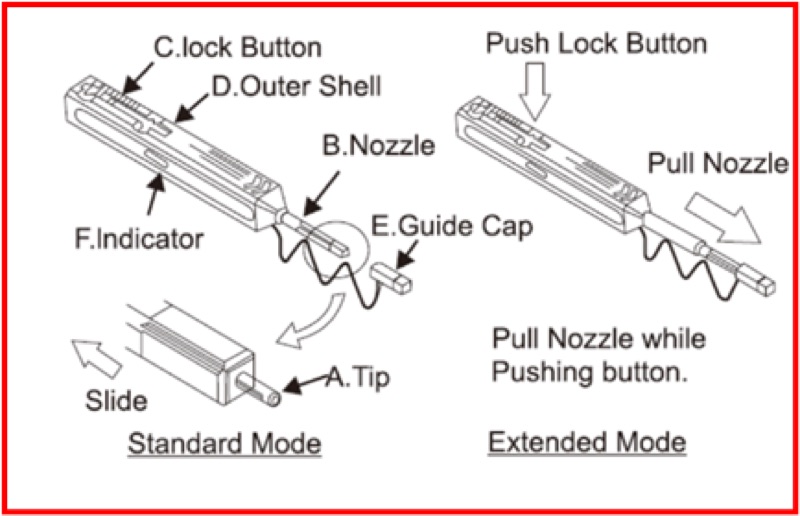
The E2000 ferrule is 2.5mm zirconia — the same diameter as FC and SC. The catch is the shutter: you need a long-reach 2.5mm cleaner that pushes past the spring-loaded plate to reach the endface. Our CLeP-25 long cleaner is built for exactly that bulkhead geometry — 750+ cleans per cartridge, shipped from a US facility rather than on European lead times.
Shop the CLeP-25 Long-Reach Cleaner →Why E2000 Matters
Laser Eye Safety
High-power optical systems present a real eye safety hazard. Class 3B lasers (typical of EDFA amplifier outputs) emit power levels (50-500 mW) that can cause permanent retinal damage in milliseconds if the beam enters the eye. Class 4 lasers (some Raman amplifier pumps) emit even higher powers (greater than 500 mW). Standard fiber connectors expose the optical port whenever they are unmated, creating risk for technicians.
The E2000's automatic shutter eliminates this exposure. A technician working in an EDFA shelf cannot accidentally look into a live fiber port -- the shutter physically blocks the path. This is why E2000 is mandated by safety policy in many European carrier networks for any application above Class 1 laser power levels.
Contamination Protection
The shutter also keeps the optical port clean. Standard connectors require dust caps when unmated; technicians sometimes forget to install them, leaving the port exposed to dust and debris. The next time a connector is mated, the contamination is pressed onto the ferrule endface, causing high insertion loss and potential damage. The E2000 shutter eliminates this failure mode by closing automatically. The port is always protected, with no manual dust cap required.
High-Density Telecom Applications
E2000 connectors are designed for the dense optical patch panels typical of European telecom central offices. The form factor is similar to SC in panel footprint but with the integrated shutter. In a DWDM line system with 40 or 80 wavelengths per fiber, every patch port might be carrying gigawatts per square meter of focused optical energy. Eye safety and contamination protection are not optional.
Where E2000 Is Used
- European telecom carrier networks: Deutsche Telekom, BT, Orange, Telefonica, and other major European operators specify E2000 in many central office and outside plant applications.
- DWDM line systems: Long-haul and metro DWDM platforms where wavelength multiplexers, demultiplexers, and inline amplifiers connect via E2000.
- Optical amplifiers (EDFA, Raman): Amplifier inputs and outputs use E2000 for eye safety on high-power ports.
- Submarine cable landing stations: Undersea cable terminal equipment frequently uses E2000 for the high-power optical interfaces between submersible repeaters and shore-side amplification.
- Test equipment and laboratory: High-power optical sources, tunable lasers, and precision interferometric test equipment.
- Laser-based fiber sensing systems: Distributed temperature sensing (DTS) interrogators with high-peak-power probe lasers.
In North American and most Asian markets, FC, SC, and LC dominate the equivalent applications. E2000 deployment in North America is largely limited to imported European equipment and specific carrier networks that have standardized on the format.
E2000 vs Other Connectors for High-Power Applications
| Connector | Eye-Safety Shutter | Region of Dominance | Typical Use |
|---|---|---|---|
| E2000 | Yes (built-in, automatic) | Europe, Asia | DWDM, EDFA, telecom CO |
| FC | No | Global telecom legacy | CATV headends, lab, telecom |
| SC | No | Global FTTH | FTTH ONTs, splitters, OSP |
| LC | No | Global data center | High-density data, transceivers |
The shutter is the only feature that distinguishes E2000 from FC or SC at the level of optical performance. Insertion loss, return loss, durability, and ferrule design are equivalent. The choice of E2000 over alternatives is driven by safety policy and regional standards, not optical performance.
Polish Variants: E2000/UPC and E2000/APC
Like other connectors, E2000 is available in UPC and APC polish variants, with the same color coding rules applying:
- E2000/UPC: Blue housing. Standard data network applications.
- E2000/APC: Green housing. DWDM, EDFA, and other applications where back-reflection control is critical (which is most E2000 applications). Far more common than UPC in practice.
The polish geometry rules are identical to those covered in our APC vs UPC explained guide. APC's -65 dB return loss is essential for the high-power, narrow-linewidth lasers typical of E2000-equipped systems.
Working with E2000 in the Field
Cleaning
Cleaning E2000 connectors requires specialized cleaners that can engage the spring-loaded shutter mechanism. The cleaner must depress the shutter to access the ferrule, clean it, and allow the shutter to close again as it withdraws. Standard one-click cleaners designed for SC, LC, or FC do not have the right geometry for E2000 adapters with shutter mechanisms. Source E2000-specific cleaners from your connector vendor or specialty cleaning suppliers.
Inspection
Inspecting an E2000 connector requires a scope that can navigate the shutter and reach the ferrule. Some scopes ship with E2000-compatible probe tips. For routine quality work, the connector ferrule itself can be inspected outside the adapter (the ferrule is exposed when the connector is unmated and the shutter is on the adapter side).
Stocking and Replacement
E2000 patch cords, pigtails, and adapters are not commonly stocked by general fiber distributors in North America. If you operate equipment that uses E2000, maintain a buffer inventory of patch cords and adapters from a specialty supplier or the equipment vendor. Lead times for emergency replacement can be weeks if you do not stock locally.
Hybrid Cables
Hybrid patch cords with E2000 on one end and SC, LC, or FC on the other are available for connecting E2000-equipped equipment to non-E2000 infrastructure. The E2000 end carries the shutter benefit; the other end loses it. For a chain of equipment where eye safety matters, all connections in the high-power path should be E2000.
Cost and Availability
E2000 connectors and patch cords are typically 2-4 times more expensive than equivalent SC, LC, or FC products. The premium reflects the precision shutter mechanism, the smaller production volumes, and the regional market concentration. For high-power applications where the shutter is required, the cost is justified. For data networks where eye safety is not a concern, alternative connectors are more economical.
Major manufacturers of E2000 connectors include Diamond (the originator), Huber+Suhner, Senko, and several European specialty manufacturers. North American distribution channels carry E2000 but with longer lead times than European equivalents.
Frequently Asked Questions
What is an E2000 connector?
The E2000 (also written E-2000 or LSH) is a single-fiber connector originally developed by Diamond SA for high-power and high-precision telecom applications. It uses a 2.5mm ceramic ferrule, a push-pull latching mechanism similar to SC, and a built-in spring-loaded shutter that automatically closes the optical port when the connector is unmated. The shutter provides laser eye safety and prevents contamination of the ferrule when not in use.
Where are E2000 connectors used?
E2000 connectors are common in European and Asian telecom networks, DWDM systems, EDFA optical amplifiers, high-power test equipment, and any application where laser eye safety is critical. They are particularly prevalent in carrier-grade central offices and submarine cable terminal stations. In North America, E2000 is less common, with FC and LC dominating equivalent applications.
Why does E2000 have a shutter?
The E2000's spring-loaded shutter serves two purposes. First, eye safety: high-power laser sources can cause permanent eye damage if a technician looks into an unmated fiber port. The shutter blocks the optical path until a connector is engaged. Second, contamination prevention: dust and debris are kept off the ferrule endface when the connector is unmated, reducing the cleaning frequency required.
Can I mate an E2000 connector to an SC adapter?
No. E2000 and SC use different mechanical housings and incompatible latching mechanisms. While both use 2.5mm ferrules internally, the connector bodies do not interoperate. Use a hybrid E2000-to-SC patch cord if you need to connect E2000 equipment to SC infrastructure.
Related Reading
- LC vs SC vs ST vs FC -- the dominant connectors that E2000 competes with in high-end applications.
- APC vs UPC Explained -- polish geometry critical for E2000's high-power use cases.
- Fiber Connector Color Codes -- the universal coding system that applies to E2000.
Ready to Keep Your E2000 Ferrules Spotless and Inspected?
E2000's shutter cuts contamination, but the ports still need 2.5mm cleaning and end-face inspection on every high-power mate. Get the long-reach cleaner and WiFi scope that handle E2000, FC, and SC ferrules in one US order, without European lead times.
Running E2000 equipment and can't find parts in North America? Talk to a fiber specialist — we'll match the right 2.5mm cleaner, scope tip, or patch cord to your gear.
E-2000® is a registered trademark of Diamond SA in the European Union, the United States, and other countries. ShopFiberOptic is not affiliated with, authorized by, or endorsed by Diamond SA.